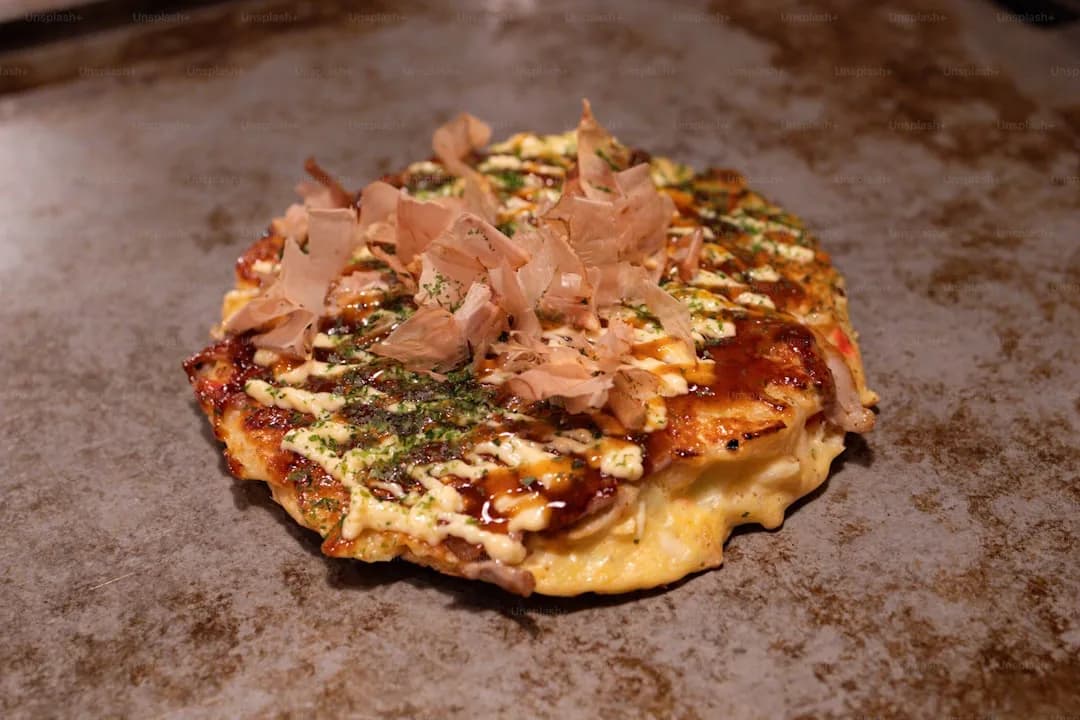
Okonomiyaki
お好み焼き (おこのみやき)
A savory Japanese pancake loaded with shredded cabbage and your choice of fillings — pork, seafood, cheese, mochi — griddled until golden and topped with a sweet-tangy sauce, mayonnaise, bonito flakes, and seaweed powder.
Overview
Okonomiyaki literally translates to 'grilled as you like it,' and that spirit of customization is what makes this dish so beloved across Japan. At its simplest, it is a thick savory pancake made from a batter of flour, eggs, dashi stock, and shredded cabbage, mixed with whatever fillings the diner desires and cooked on a flat iron griddle (teppan). The two major styles — Osaka and Hiroshima — inspire fierce regional loyalty and friendly rivalry. In Osaka, all ingredients are mixed together into a thick batter and griddled. In Hiroshima, the components are layered: a thin crepe, mountains of cabbage, pork, yakisoba noodles, and a fried egg are stacked and pressed together. Both styles are finished with a glossy coating of otafuku sauce (a Worcestershire-like sweet fruit sauce), a zigzag of Japanese mayonnaise, a shower of katsuobushi (dancing bonito flakes), and a dusting of aonori (green seaweed powder). In Osaka especially, okonomiyaki restaurants are social hubs where friends gather around a shared griddle, drinking beer and cooking together.
Origin & History
Region: Osaka and Hiroshima
Okonomiyaki's roots trace to the Edo period dish 'funoyaki,' a thin crepe served at Buddhist ceremonies. In the 1930s, a simpler version called 'issen yoshoku' (one-penny Western food) became popular street food. After World War II, when rice was scarce but flour was available through American aid, the modern cabbage-heavy okonomiyaki emerged as an affordable, filling meal. Osaka and Hiroshima each developed their own distinct styles. The dish grew from post-war necessity food into one of Japan's most beloved comfort foods, and both cities now celebrate it as a cornerstone of their culinary identity.
Ingredients
Main Ingredients
- Flour, eggs, dashi stock, and grated nagaimo yam (batter)
- Shredded cabbage (the backbone of the dish)
- Thinly sliced pork belly (buta)
- Tenkasu (tempura scraps for crunch)
How to Order
At most okonomiyaki restaurants, you choose a base style and add toppings. 'Buta-tama' (pork and egg) is the standard starting point. 'Mix' or 'deluxe' sets add seafood. At self-cook restaurants (common in Osaka), the staff will bring ingredients mixed in a bowl with spatulas — you cook it on the tabletop teppan. Flip when the bottom is golden (about 4-5 minutes per side). At staff-cooked restaurants (standard in Hiroshima), just order and wait. Say 'okonomiyaki hitotsu' for one pancake.
Variations
Osaka-style (Kansai-style)
All ingredients are mixed together in a bowl, poured onto the griddle, and shaped into a thick round pancake. The batter often includes grated nagaimo yam for a lighter, fluffier texture. Diners at many restaurants cook it themselves on a tabletop teppan.
Hiroshima-style
A layered construction: a thin crepe is topped with a massive pile of cabbage, pork, bean sprouts, yakisoba noodles, and a fried egg, all pressed together. The result is much thicker and heartier than Osaka-style. The noodle layer is distinctive.
Modanyaki
An Osaka variation that adds a layer of yakisoba or udon noodles to the standard Osaka-style pancake, bridging the gap between Osaka and Hiroshima styles. Extremely filling.
Negiyaki
An Osaka variation using a thinner batter loaded with chopped green onions instead of cabbage, resulting in a crispier, lighter pancake often compared to a savory crepe.
Where to Eat
Mizuno
Dotonbori, Osaka
One of Osaka's most famous okonomiyaki restaurants, operating since 1945. Known for their 'yamaimoyaki' using generous amounts of mountain yam for an incredibly fluffy texture. Often has a queue.
Nagata-ya
Hiroshima
Widely considered one of the best Hiroshima-style okonomiyaki restaurants. Located near the Peace Memorial Park. Their signature pancake with extra noodles and egg is a masterclass in layered construction.
Okonomimura
Hiroshima
A multi-story building containing over 20 individual okonomiyaki stalls on floors 2-4. Pick any stall, sit at the counter, and watch the chef build your Hiroshima-style okonomiyaki on the griddle before you.
Kiji
Umeda, Osaka (Shin-Umeda Food Court)
Tiny but legendary shop in the underground food court beneath Umeda Sky Building. Famous for their modanyaki with yakisoba noodles. Expect a 30-minute wait.
Price Range
Street Food / Casual
600 - 900 JPY ($4 - $6) for a basic okonomiyaki
Restaurant
900 - 1,800 JPY ($6 - $12) for premium toppings or mix sets
Upscale / Fine Dining
2,000 - 3,500 JPY ($14 - $24) at high-end teppanyaki-style restaurants
Tips
- In Osaka, many restaurants let you cook it yourself — do not press down on the pancake with the spatula or you will squeeze out moisture and make it dense
- Use the small metal spatula (kote/hera) to cut and eat directly off the griddle — this keeps the okonomiyaki hot
- Apply sauce generously — the sweet-tangy sauce is essential to the flavor profile
- Watch the bonito flakes dance on top from the heat — this is a signature visual moment and means the okonomiyaki is still piping hot
- In Hiroshima, do not attempt to flip it yourself at staff-cooked restaurants — the layered construction requires expert technique
- Pair okonomiyaki with a cold Japanese beer — it is one of Japan's great food-and-drink combinations
Cultural Notes
Okonomiyaki is deeply tied to the post-war recovery story of both Osaka and Hiroshima. In Hiroshima, the dish holds particular significance: after the atomic bombing in 1945, okonomiyaki stalls were among the first businesses to reopen, providing affordable, filling meals from simple ingredients to a devastated population. The dish became a symbol of resilience and community rebuilding. Today, Hiroshima has over 2,000 okonomiyaki restaurants for a city of 1.2 million people. In Osaka, the dish reflects the city's 'kuidaore' (eat until you drop) food culture and its egalitarian spirit — okonomiyaki restaurants are places where all social classes mix freely. The Osaka vs. Hiroshima rivalry over whose style is superior is one of Japan's most passionate (and friendly) food debates.
Sources
- Japan National Tourism Organization (JNTO)
- Osaka Convention & Tourism Bureau
- Hiroshima Prefecture Tourism Guide
- Lonely Planet Japan Food Guide