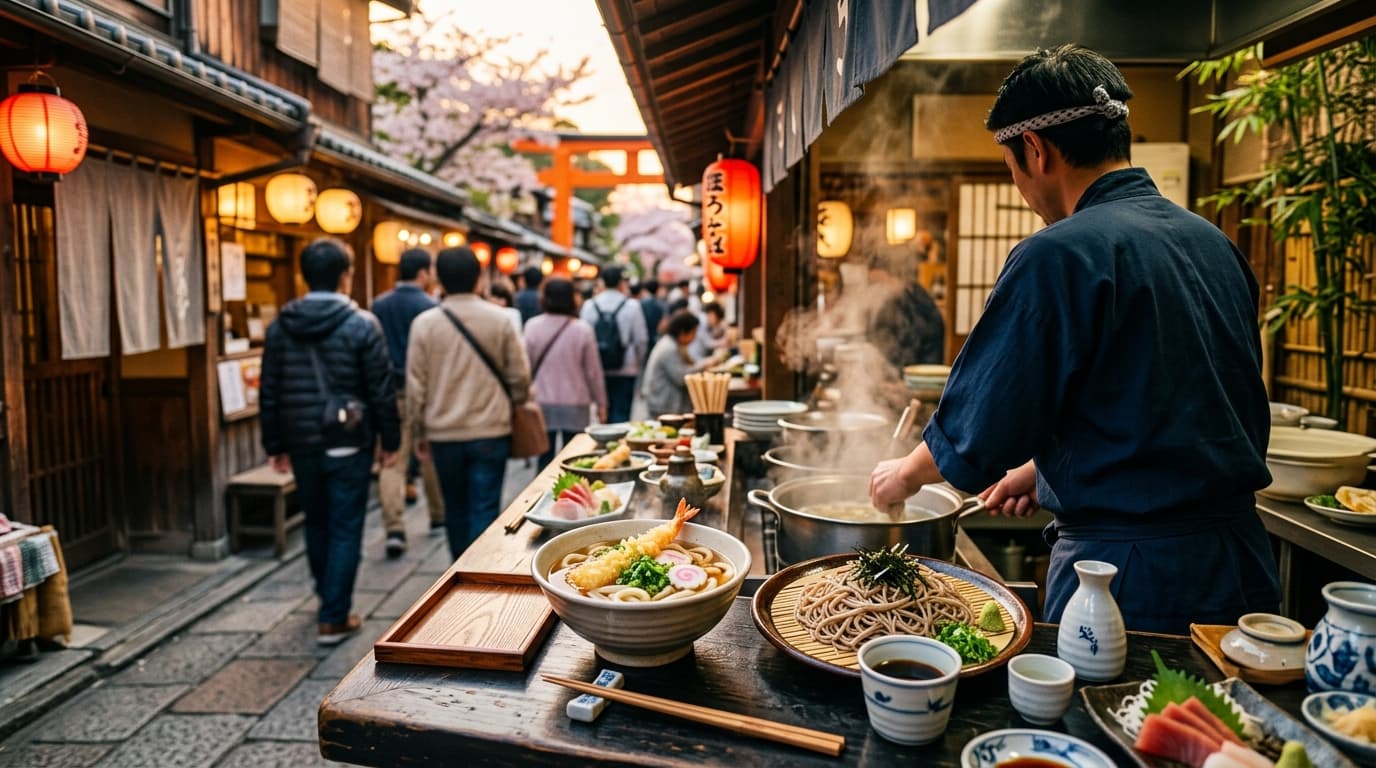
Stand in a crowded noodle shop in Tokyo during lunch rush, and you'll witness a beautiful ritual: salarymen slurping udon and soba with the intensity of a competitive sport. These two noodles aren't just food—they're cultural touchstones that divide Japan into regions, seasons, and deeply personal preferences. But what's the real difference, and which should you order?
Key Takeaways
| Question | Answer |
|---|---|
| What's the main difference? | Udon is thick wheat noodles; soba is thinner buckwheat noodles with a nutty flavor |
| Which is healthier? | Soba has more protein and fiber; udon is comfort food but heavier |
| How much does a bowl cost? | ¥600–¥1,200 ($4–$8 USD) for a basic bowl at a casual shop |
| When should I eat each? | Udon year-round (warming); soba in summer (cold) or winter (hot) |
| Where's the best place to try both? | Osaka for udon, Kyoto for soba, or any regional specialty area |
| Do I need to book? | No—most noodle shops are walk-in only; arrive before noon or after 2pm to avoid queues |
| What's the proper etiquette? | Slurp loudly (it's polite!), use chopsticks and a spoon, and finish your broth if it's a gift |
Some links in this article are affiliate links — if you book through them, we earn a small commission at no extra cost to you. This helps us keep go2-japan.com free and up to date.
1. The Fundamental Difference: Wheat vs. Buckwheat
Udon and soba are Japan's two most iconic noodle types, and their differences run deep—starting with what they're made from. Udon noodles are crafted from wheat flour, water, and salt, creating thick, chewy strands that can range from 2mm to 4mm in diameter. Soba noodles, by contrast, are made from buckwheat flour (often blended with wheat flour for texture), resulting in thinner, more delicate noodles with a distinctive earthy, nutty flavor.
When we explored noodle shops across our Tokyo travel guide neighborhoods, the textural contrast became immediately obvious. Udon has a soft, pillowy bite—almost cloud-like—while soba snaps between your teeth with a subtle resistance. This isn't just semantics; it fundamentally changes how each noodle absorbs broth, pairs with toppings, and sits in your stomach. Udon feels indulgent and warming, while soba feels refined and slightly more austere.
The Wheat Foundation of Udon
Udon's simplicity is deceptive. The dough requires careful kneading and resting to develop the right gluten structure, which gives the noodles their signature chewiness. Traditional udon-making is almost meditative—artisans spend years perfecting the knead-and-fold technique. The noodles are boiled until they're tender but still retain a slight firmness (what Japanese cooks call "al dente," though the concept predates Italian influence in Japan).
The Buckwheat Character of Soba
Soba's buckwheat base makes it inherently more complex. Buckwheat is naturally gluten-free and packed with protein, B vitamins, and minerals—which is why soba has long been considered the more "refined" choice among health-conscious eaters. The buckwheat flavor is subtle but unmistakable: slightly sweet, earthy, with a hint of grassiness. Pure soba (100% buckwheat) is rare and expensive; most restaurants blend it with wheat flour (typically 80% buckwheat, 20% wheat) to improve texture and prevent the noodles from becoming too fragile.
Did You Know? Soba contains all nine essential amino acids, making it a complete protein source—unusual for a grain-based food. This nutritional profile made soba a staple for Buddhist monks and working-class laborers throughout Japanese history.
Source: NHK World
2. Regional Styles and Where They Thrive
Japan's noodle culture is fiercely regional. Travel across the country and you'll discover that udon and soba aren't monolithic—they're deeply tied to local ingredients, climate, and tradition. Understanding these regional variations is key to eating like a local.
Udon Strongholds: Kagawa and Kansai
Kagawa Prefecture, on the island of Shikoku, is the undisputed udon capital of Japan. Sanuki udon, the regional specialty, is thinner and firmer than most udon styles, with a chewy texture that comes from a specific kneading technique. During our time exploring the Kansai region guide, we discovered that Osaka and Hyogo prefectures also have strong udon traditions—particularly kake udon (plain udon in hot broth) and kitsune udon (topped with fried tofu pockets).
The key difference in Kansai udon is the broth. Rather than the rich, soy-heavy broths of eastern Japan, Kansai broths tend to be lighter and more delicate, allowing the noodle texture to shine. When we visited local shops in Osaka travel guide neighborhoods, we noticed that many serve udon with a simple dashi broth and minimal toppings—a philosophy that reflects the region's aesthetic preference for simplicity.
Soba Strongholds: Kyoto, Tokyo, and Nagano
Soba is the noodle of choice in cooler, mountainous regions where buckwheat grows well. Kyoto travel guide neighborhoods are dotted with soba shops, many of which have operated for centuries. Kyoto's nishin soba (soba topped with herring) and kitsune soba (with fried tofu) are local classics. Tokyo has its own soba tradition, heavily influenced by Edo-period street food culture—Tokyo soba tends to be served in a darker, more assertive broth than Kyoto's lighter version.
Nagano Prefecture, in the Japanese Alps, is famous for soba production and consumption. The cooler climate is perfect for buckwheat cultivation, and locals eat soba year-round. During our hiking trips through the Chubu Tohoku region guide, we found that mountain villages often serve zaru soba (cold soba on a bamboo mat) in summer and kake soba (hot soba) in winter.
| Region | Noodle | Style | Key Characteristic |
|---|---|---|---|
| Kagawa | Udon | Sanuki | Thin, firm, chewy |
| Osaka/Kansai | Udon | Kake/Kitsune | Light broth, minimal toppings |
| Kyoto | Soba | Nishin/Kitsune | Delicate, herring topping |
| Tokyo | Soba | Edo-style | Dark broth, assertive flavor |
| Nagano | Soba | Mountain style | Pure buckwheat, seasonal |
3. Broth Styles: The Soul of the Bowl
The broth is where udon and soba truly diverge in character. While the noodles are the star, the broth is the supporting actor that can elevate or diminish the entire experience.
Udon Broths: Rich and Warming
Udon broths are typically built on a foundation of dashi (Japanese stock made from kombu seaweed and bonito flakes), soy sauce, mirin (sweet rice wine), and salt. The result is a warm, savory liquid that clings to the thick noodles and provides comfort. In eastern Japan (Kanto region), udon broths tend to be darker and more robust, with a pronounced soy flavor. In western Japan (Kansai), broths are lighter and more delicate, sometimes almost clear.
Kare udon (curry udon) is a modern innovation that's become wildly popular—thick udon noodles in a mild Japanese curry broth, often topped with chicken or vegetables. When we visited casual udon shops in Tokyo, we noticed that curry udon attracts a younger demographic and office workers looking for something hearty and different from the traditional broths.
Soba Broths: Subtle and Refined
Soba broths are typically lighter than udon broths, designed not to overwhelm the delicate buckwheat flavor. The classic soba broth is made from dashi, soy sauce, and mirin—similar ingredients to udon broth, but in different proportions, resulting in a more nuanced, less aggressive flavor. Cold soba is served with a separate dipping sauce called tsuyu, which is more concentrated and intense than the broth served with hot soba.
The distinction matters: when eating zaru soba (cold soba), you dip each bite into the tsuyu, controlling the intensity of flavor. This creates an interactive eating experience quite different from udon, where the noodles are already swimming in broth.
- Udon Broth Characteristics: Rich, warming, soy-forward, clings to noodles
- Soba Broth Characteristics: Delicate, subtle, designed to complement rather than dominate
- Temperature Matters: Udon is almost always served hot; soba can be hot or cold depending on season and style
4. Seasonal Eating: When to Order What
Japanese food culture is deeply seasonal, and noodle consumption follows these rhythms. Understanding when to eat udon versus soba isn't just about preference—it's about eating in harmony with the season.
Summer: The Season of Cold Soba
In summer, when temperatures soar above 30°C (86°F), zaru soba becomes the noodle of choice across Japan. Cold soba is refreshing, light, and doesn't heat up your body the way hot noodles would. The cold also highlights soba's delicate buckwheat flavor in a way that hot broth sometimes masks. During our summer visits to Kyoto travel guide neighborhoods, we noticed that soba shops set up outdoor seating and serve ice-cold noodles with a concentrated dipping sauce.
Cold udon (hiyamen or udon no hiyatsuyu) exists but is far less common than cold soba. When udon is served cold, it's often in a light, chilled broth rather than as a dipping experience.
Winter and Spring: Udon's Moment
Udon dominates in colder months. The thick, warming noodles and rich broths are perfect for January through March, when temperatures drop. Hot udon provides genuine comfort—there's a reason Japanese people eat udon when they're sick or tired. In spring, as temperatures begin to warm but before summer heat arrives, both noodles coexist peacefully.
Did You Know? In Japan, eating soba on New Year's Eve is a tradition believed to bring longevity and good fortune. The long noodles symbolize a long life, and the buckwheat's strength represents resilience through hardship.
5. Toppings and Flavor Combinations
Both udon and soba are canvases for toppings, but the classic pairings differ based on what complements each noodle's character.
Classic Udon Toppings
Kitsune udon (with fried tofu pockets) is perhaps the most iconic udon topping—the sweet, slightly crispy tofu contrasts beautifully with the chewy noodles and savory broth. Tempura udon adds crispy shrimp or vegetable tempura on top or on the side. Negi udon (with scallions) is the minimalist's choice, letting the noodle quality shine.
During our exploration of casual udon shops in Osaka travel guide, we noticed that toppings tend to be generous and hearty—fried tofu, chicken, mushrooms, and vegetables. Udon can handle bold flavors and substantial toppings without losing its identity.
Classic Soba Toppings
Soba's delicate flavor pairs beautifully with more refined toppings. Tempura soba (with shrimp tempura) is beloved because the crispy exterior contrasts with the tender noodles. Kitsune soba uses the same fried tofu as udon but in smaller quantities. Nishin soba (with herring) is a Kyoto specialty—the umami-rich fish complements soba's earthiness perfectly.
Toro soba (with grated daikon radish and a raw egg) is a summer favorite—the cool, crisp daikon and rich egg yolk create a complex flavor profile that's lighter than hot soba but more substantial than plain zaru soba.
- Best Udon Toppings: Fried tofu (kitsune), tempura, chicken, mushrooms, scallions
- Best Soba Toppings: Tempura, herring (nishin), grated daikon, raw egg, nori (seaweed)
- Pro Tip: Order toppings on the side if you want to control how much you add—most shops will accommodate this request
6. Texture and Mouthfeel: The Eating Experience
The physical experience of eating udon versus soba is remarkably different, and this difference matters more than many travelers realize.
Udon's Pillowy Softness
Udon noodles are meant to be soft and yielding. When you bite into a perfectly cooked udon noodle, it should collapse gently between your teeth without requiring much chewing. This softness is intentional—it's not undercooked; it's the desired texture. The thick noodles absorb broth readily, and each bite delivers a mouthful of warm, savory liquid.
In our experience visiting traditional udon shops, we noticed that the best udon has a slight resistance at the very center—a tiny bit of firmness that prevents it from being mushy. This is called koshi (resilience or backbone), and it's the mark of well-made udon.
Soba's Delicate Snap
Soba noodles are thinner and more delicate, with a slight firmness that creates a subtle snap when you bite. This texture is crucial to the eating experience. Overcooked soba becomes mushy and loses its character; undercooked soba is unpleasantly hard. The ideal soba has a slight resistance that gives way to a tender interior.
Cold soba emphasizes this texture even more. When you dip cold soba into tsuyu, the contrast between the cool noodles and warm dipping sauce creates a multi-sensory experience that's quite different from eating hot noodles in broth.
The Slurping Question
Both noodles are meant to be slurped—loudly. In Japan, slurping is not just acceptable; it's encouraged. The slurping action cools the noodles slightly (important for hot noodles) and aerates them, allowing you to taste the full flavor. It's also a sign of appreciation to the chef. When we ate at busy noodle shops in Tokyo, the symphony of slurping was constant and celebratory.
7. Nutritional Profiles and Health Considerations
If you're trying to make a health-conscious choice between udon and soba, the data is clear—but both have merits depending on your goals.
Soba's Nutritional Edge
Soba is the nutritional winner. Buckwheat contains all nine essential amino acids, making it a complete protein. A typical bowl of soba (about 200g of cooked noodles) contains roughly 6-8g of protein, plus significant amounts of fiber, magnesium, and B vitamins. Soba is also lower in calories than udon—typically 150-200 calories per bowl compared to udon's 250-350 calories.
For people watching their weight or seeking sustained energy, soba is the smarter choice. The fiber content also aids digestion and helps maintain stable blood sugar levels.
Udon's Comfort Factor
Udon is higher in calories and carbohydrates, making it less ideal for low-carb diets. However, the thick noodles and rich broth create a sense of satiation that lasts longer than soba. For travelers who are walking extensively and burning calories (which you will be in Japan), udon's extra calories aren't a concern—they're fuel.
The warming properties of udon also have genuine health benefits. In Japanese traditional medicine, warm foods are considered easier to digest and more nourishing than cold foods. This isn't just folklore; warm broths do aid digestion and nutrient absorption.
- Soba Advantages: Complete protein, higher fiber, lower calorie, sustained energy
- Udon Advantages: More satisfying, warming (aids digestion), better for cold weather
- Honest Take: Both are relatively healthy compared to Western fast food; the difference is modest
8. How to Order Like a Local
Walking into a busy noodle shop for the first time can feel intimidating, but the process is straightforward once you know the basics. Most shops operate on a simple system: order at a counter, pay immediately, and find a seat.
Reading the Menu and Ordering
Most noodle shops have a visual menu with plastic displays or photos. Point to what you want, or use these key phrases:
- "Udon kudasai" (One udon, please)
- "Soba kudasai" (One soba, please)
- "Kake udon" (Plain udon in broth)
- "Zaru soba" (Cold soba on a mat)
- "Tempura udon/soba" (With tempura)
Size matters. Most shops offer regular (futsuu) and large (ōkii), sometimes small (chiisai). When we visited busy shops in Tokyo travel guide neighborhoods, we noticed that ordering small is perfectly acceptable—no judgment.
Eating Etiquette
Once your noodles arrive, here's what to do:
- Slurp loudly. This is polite and expected. The noise signals enjoyment to the chef.
- Use chopsticks and a spoon. The spoon is for catching noodles and broth; use it to guide noodles to your mouth.
- Finish the broth if possible. Leaving broth is considered wasteful, though no one will force you.
- Don't add condiments without tasting first. Try the noodles plain before adding soy sauce or chili oil.
- Eat quickly. Noodles are best consumed immediately after serving. Sitting around makes them soggy.
Common Condiments and Add-ons
Most noodle shops have a small table with condiments:
- Shichimi togarashi (seven-spice chili powder) — adds heat and complexity
- Soy sauce (shoyu) — adds saltiness and umami
- Chili oil (rayu) — adds heat and richness
- Vinegar (su) — adds brightness (especially good with soba)
- Sesame seeds (goma) — adds nuttiness
For soba, a small dish of wasabi (Japanese horseradish) is often provided. A tiny dab in your dipping sauce creates a pleasant nasal heat.
9. Where to Eat: Regional Recommendations
Finding excellent udon and soba doesn't require fancy restaurants or reservations. Some of the best bowls come from humble shops that have perfected their craft over decades.
Must-Visit Udon Destinations
Kagawa Prefecture is the pilgrimage destination for udon lovers. The prefecture has over 600 udon shops, and locals eat udon multiple times per week. Sanuki udon shops range from humble roadside stands to slightly more formal establishments. In our experience, the best Sanuki udon comes from small family-run shops in towns like Takamatsu and Marugame.
Osaka deserves a dedicated udon exploration. The city's casual udon culture is different from Kagawa's—less precious, more integrated into daily life. Shops serve udon alongside other quick dishes, and you'll often see salarymen eating udon at a counter in under 10 minutes.
Must-Visit Soba Destinations
Kyoto is the soba capital for travelers. The city's soba shops are concentrated in neighborhoods like Gion and around the temples. Many have operated for 50+ years and maintain traditional preparation methods. Kyoto travel guide neighborhoods like Higashiyama are particularly rich with soba options.
Tokyo's soba culture is rooted in Edo-period street food. Shops in neighborhoods like Asakusa and Shinjuku serve traditional Tokyo-style soba with dark, assertive broths. When we explored hidden gems Tokyo, we discovered that some of the best soba shops are tucked into narrow alleys and easy to miss.
Nagano Prefecture offers a different soba experience—mountain villages where soba is made fresh daily and served with seasonal ingredients. The buckwheat flavor is more pronounced because the noodles are fresher and often contain higher percentages of pure buckwheat.
- Best for Udon: Kagawa (Sanuki), Osaka (casual culture), Kansai region
- Best for Soba: Kyoto (refined tradition), Tokyo (Edo-style), Nagano (mountain purity)
- Insider Tip: Visit noodle shops between 11am-1pm or 5pm-7pm to avoid the worst crowds
10. Udon vs. Soba: Direct Comparison
Let's put them side by side to help you decide which to order based on your preferences and circumstances.
| Aspect | Udon | Soba |
|---|---|---|
| Main Ingredient | Wheat flour | Buckwheat flour (usually 80%) |
| Texture | Thick, soft, pillowy | Thin, delicate, slight snap |
| Flavor | Mild, lets broth shine | Nutty, earthy, distinctive |
| Broth | Rich, warming, soy-forward | Delicate, subtle, often dipping sauce |
| Best Season | Winter, spring, year-round | Summer (cold), winter (hot) |
| Calories | 250-350 per bowl | 150-200 per bowl |
| Protein | 6-8g per bowl | 6-8g per bowl (complete) |
| Fiber | Low | High |
| Best For | Comfort, warmth, hearty appetite | Refinement, lighter meal, health-conscious |
| Regional Hub | Kagawa, Osaka | Kyoto, Tokyo, Nagano |
| Typical Price | ¥700-¥1,200 | ¥700-¥1,200 |
| Slurping | Essential | Essential |
| Difficulty Level | Easy (forgiving texture) | Medium (texture matters) |
The honest answer: try both. They're not competitors; they're complementary expressions of Japanese noodle culture. Eat udon when you want comfort and warmth, soba when you want refinement and lightness.
Frequently Asked Questions
What's the difference between udon and ramen?
Can I eat udon or soba if I'm gluten-free?
Pure soba (100% buckwheat) is gluten-free, but most restaurants serve soba with 20% wheat flour blended in for texture. Ask for juwari soba (pure buckwheat soba) if you have celiac disease. Udon is made from wheat and contains gluten. Some restaurants may have gluten-free alternatives, but they're rare in Japan.
Why do Japanese people slurp noodles so loudly?
Slurping serves multiple purposes: it cools hot noodles slightly, aerates them to enhance flavor perception, and signals appreciation to the chef. It's also practical—slurping helps you eat noodles faster before they absorb too much broth and become soggy. In Japan, slurping is polite and expected.
What's the best time of day to eat udon or soba?
Both are eaten at any time, but lunch (11am-2pm) is peak noodle time. Many shops close by 3pm and reopen for dinner around 5pm. Breakfast udon exists in some regions, particularly in Kagawa. Avoid eating immediately before bed—the heavy broth can interfere with sleep.
How do I know if udon or soba is fresh?
Fresh udon should have a slight firmness and a faint wheat smell. The noodles should hold together in the broth without falling apart. Fresh soba has a delicate buckwheat aroma and a slight snap when bitten. If noodles are mushy or smell off, the shop isn't maintaining quality. Busy shops with high turnover usually have fresher noodles.
Is it rude to leave broth in the bowl?
Finishing broth is considered respectful, but it's not mandatory. If you're full, leaving some is acceptable. However, finishing the broth—especially in a small bowl—is appreciated by the chef and considered a compliment. In casual settings, no one will judge you for leaving broth.
What's the difference between hot and cold soba?
Hot soba (kake soba) is served in warm broth, similar to udon. Cold soba (zaru soba) is served on a bamboo mat with a separate dipping sauce. Cold soba is more popular in summer; hot soba is eaten year-round. Cold soba allows you to control the intensity of flavor by adjusting how much dipping sauce you use.
Conclusion
Udon and soba aren't rivals—they're two expressions of the same Japanese philosophy: taking simple ingredients and perfecting technique to create something transcendent. Udon is the comfort noodle, thick and warming, perfect for winter and for when you need genuine sustenance. Soba is the refined noodle, delicate and complex, perfect for summer and for when you want to taste the nuance of buckwheat.
During your time in Japan, eat both. Visit a humble udon shop in Osaka travel guide neighborhoods and a traditional soba restaurant in Kyoto travel guide. Slurp loudly. Try regional variations. Notice how the same noodle tastes different depending on the water, the broth, the season, and the chef's hands.
For more deep dives into Japanese cuisine, explore our complete Japanese food guide and regional food specialties. And when you're planning your Japan travel guide 2026, remember: noodle shops are where you'll find the most authentic Japan.
Trust us on this: the best meal you have in Japan might cost ¥800 and take 10 minutes to eat. And you'll remember it forever.
Sources & References
This article is based on first-hand experience and verified with the following official sources:

Go2Japan Team
Exploring Japan since 2021 | 35+ prefectures visited | Updated monthly
We are a team of travel writers and Japan enthusiasts who explore the country year-round. Our guides are based on first-hand experience, local knowledge, and verified official sources.
More about us →People Also Read

Japan eSIM and Internet Guide for Travelers: Complete 2026 Guide
Complete guide to staying connected in Japan: eSIM options, SIM cards, WiFi, costs, and setup steps for travelers.

Vegetarian and Vegan Food in Japan: Practical Guide
Navigate vegetarian and vegan dining in Japan with our practical guide to Buddhist cuisine, regional specialties, and how to order like a local.

Japan Visa Requirements 2026: Complete Tourist Guide
Complete 2026 guide to Japan visa requirements for tourists. Visa-free entry, tourist visas, eVisas, costs, and step-by-step application process.

Japan Street Food and Markets: What to Try First
Discover Japan's best street food and markets. Learn what to try first, where to find authentic vendors, and how to order like a local.
Plan Your Japan Trip
Book hotels, transport, activities, and get connected with an eSIM
Some links are affiliate links. We may earn a commission at no extra cost to you.