Cherry Blossom Season Japan: When, Where & How
Every spring, the sakura front moves north through Japan like a slow pink tide. It starts in Okinawa in late January. By late March it reaches Tokyo and Kyoto. By early May it peaks in Hokkaido. For roughly six weeks -- with just a week or ten days of true peak bloom in any one place -- Japan transforms. Parks fill with blue tarps, benches disappear under food stalls, and riverbanks that are unremarkable the rest of the year become genuinely beautiful. This is sakura season, and this guide explains exactly how to time it, find the best spots, and experience it without being crushed by the crowds.
Understanding the Sakura Bloom Cycle
Cherry blossom timing is not a fixed calendar date -- it is determined by winter and early spring temperatures. A warm February pushes the front forward; a cold April delays it. Japan's sakura forecasters (the Japan Meteorological Corporation publishes forecasts updated weekly from January) track this front city by city.
The key bloom stages:
| Stage | Description |
|---|---|
| Kaika (開花) | First bloom -- a few flowers open on the sample tree |
| 20-50% bloom | Trees are visibly flowering but not yet full |
| Mankai (満開) | Full bloom -- 80%+ of flowers open; peak hanami window |
| Hanafubuki (花吹雪) | "Blossom blizzard" -- petals begin to fall; lasting 3--5 days after mankai |
| Hazakura (葉桜) | Leaves appear; season ends |
The hanami window -- when the trees are fully in bloom and the petals have not yet fallen -- lasts approximately 5--7 days under good conditions. Rain and wind can cut it shorter. This narrow window is why cherry blossom travel requires flexibility and planning.
When Sakura Blooms: City-by-City Timeline
Average Bloom Dates (Historical, Subject to Annual Variation)
| Location | First Bloom | Full Bloom (Mankai) |
|---|---|---|
| Naha, Okinawa | Late January | Early February |
| Fukuoka | Late March | Early April |
| Hiroshima | Late March | Early April |
| Osaka | Late March -- early April | Early April |
| Kyoto | Late March -- early April | Early April |
| Tokyo | Late March -- early April | Early April |
| Nagano | Early April | Mid-April |
| Sendai (Tohoku) | Mid-April | Late April |
| Aomori / Hirosaki | Late April | Late April -- early May |
| Sapporo, Hokkaido | Late April | Early May |
2026 update: The sakura front arrived earlier than average across Japan. Tokyo's first blooms opened March 19, with full bloom on March 28 -- approximately 3--5 days ahead of the historical average, driven by an unusually warm February.
Best Hanami Spots in Japan
Tokyo
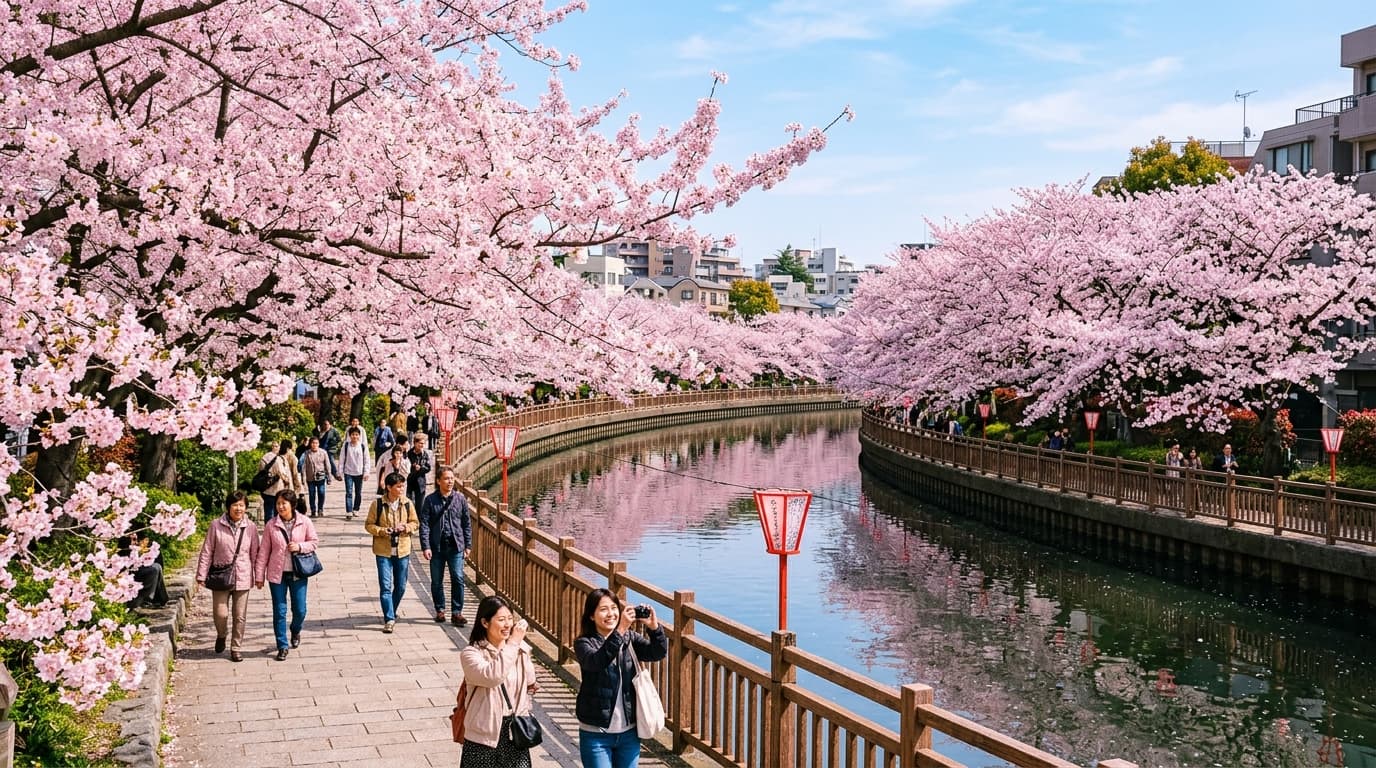
Meguro River: The canal running through Nakameguro is lined with approximately 800 cherry trees on both banks. At full bloom, the branches form a canopy over the water. In the evening, the trees are lit with warm lanterns and pink petals drift on the water. This is Tokyo's most photographed hanami location. Extremely crowded during peak bloom -- go before 9am for manageable crowds and better photos.
Shinjuku Gyoen National Garden: One of Japan's largest parks, with 1,500 trees of 65 different species -- including early-blooming and late-blooming varieties that extend the season. Entry ¥500. The mix of species means the garden is beautiful for longer than most single-variety spots. Alcohol is prohibited inside the park, making it a calmer alternative to city parks.
Chidorigafuchi: A moat surrounding part of the Imperial Palace, with cherry trees leaning over the water. Rowboats are available for hire during bloom season -- the view from the water looking up at the canopy is memorable. Free to walk along the moat path.
Ueno Park: The classic Tokyo hanami location -- massive, boisterous, full of food stalls and blue tarp picnics from sunrise. Over 1,000 trees and a festive atmosphere that is quintessentially Japanese. Bring your own food and find a spot early.
Yoyogi Park and Hanamiyashiki (Yanaka): Yoyogi is less formal and more neighborhood-oriented -- families, musicians, casual groups. Yanaka's Yanaka Cemetery (Yanaka Reien) has long alleys of cherry trees and is far less crowded than famous parks.
Kyoto
Maruyama Park: The symbolic heart of Kyoto hanami, centered around a massive 80-year-old weeping cherry tree (shidare-zakura) lit with lanterns in the evening. The nighttime illuminations transform the tree into something extraordinary. Extremely crowded -- plan to visit in the evening when the lantern light is best.
Philosopher's Path (Tetsugaku no Michi): A 2km canal-side path in the Higashiyama district lined with cherry trees. Named after philosopher Nishida Kitaro, who reportedly walked here to think. Walk it in the morning for relative quiet. See our Kyoto guide for more on this area.
Nijo Castle: The castle grounds have multiple varieties of cherry trees including early-blooming species that create a layered bloom sequence. The combination of the white castle walls, stone gardens, and pink blossom is particularly refined. Entry ¥800.
Kiyomizu-dera: Kyoto's most famous temple has special nighttime illuminations during cherry blossom season, opening after dark for a dramatic view of the city below and the temple's wooden stage surrounded by lit blossoms.
Fushimi Momoyama: Less visited than the above, the Fushimi Castle area has beautiful cherry blossoms and far smaller crowds than central Kyoto.
Beyond Tokyo and Kyoto
Hirosaki Castle, Aomori (Tohoku): One of Japan's most celebrated cherry blossom sites. Over 2,600 trees of 50 varieties fill the castle moat and grounds. The moat in full bloom, with pink petals floating on the water, is one of Japan's great spring images. Peak bloom is typically late April (2--3 weeks after Tokyo). The Hirosaki Cherry Blossom Festival runs late April to early May.
Yoshino, Nara Prefecture: A mountainside covered with 30,000 cherry trees -- white on the lower slopes, pink in the middle, and deep pink at the top. Yoshino has been a famous blossom-viewing site since the 7th century. It is steep, crowded, and requires careful timing, but it is unlike any other sakura site in Japan.
Kakunodate (Akita): A preserved samurai district with weeping cherry trees lining the old samurai residences -- a combination of historical atmosphere and spring bloom that is rare anywhere in Japan. Quieter and more intimate than major city parks.
Lake Kawaguchiko (Fuji Five Lakes): The cherry trees along the north shore of Lake Kawaguchi bloom about a week later than Tokyo, with Mount Fuji as backdrop. The Chureito Pagoda view -- pagoda framed against Fuji with blossoms in the foreground -- is one of Japan's most iconic photographs.
Hitachi Seaside Park, Ibaraki: Known primarily for its autumn kochia (fireweed) season, but the park's cherry avenue is beautiful in late March to early April and crowds are a fraction of Tokyo parks.
Hanami Culture: How to Participate
Hanami is not simply looking at flowers. It is a social occasion -- gathering outdoors under or near the trees with food, drinks, and company. The tradition dates to the Nara period (710--794), when it was a court practice involving Japanese plum (ume) trees. By the Heian period (794--1185) it had shifted to sakura, and by the Edo period it was a mass urban celebration.
The blue tarp (burashia) tradition: In public parks, the ground under cherry trees fills with groups sitting on blue plastic sheets, eating and drinking together. In Ueno Park and Yoyogi Park, spots under the best trees are claimed by office workers who arrive before dawn on weekdays to hold them for their colleagues' lunchtime hanami.
Food and drink: Bento boxes, onigiri, sakura mochi (pink rice cake wrapped in a pickled cherry leaf), hanami dango (three-color skewered rice dumplings -- pink, white, green), beer, sake, and canned cocktails are the staples. Food stalls set up near the best hanami parks during peak season.
Evening hanami (yozakura): Many parks and temples offer special nighttime illuminations (yakata-boshi) during peak bloom, turning the trees with warm light. Maruyama Park in Kyoto, the Meguro River in Tokyo, and Osaka Castle Park are especially atmospheric for yozakura.
What to bring: A waterproof sheet or tarp for sitting on, a bag for trash (no trash bins in Japanese parks -- take it with you), food and drinks, layers (evenings can be cold during sakura season), and a sense of patience for crowds.
Avoiding the Crowds
Cherry blossom season is the single most crowded period in Japanese tourism. A few strategies:
Go early or late in the day. Most Instagram crowds are 10am--3pm. Before 8am at Meguro River or Chidorigafuchi, the light is better and the people are fewer.
Choose secondary sites. For every famous spot, there is a less-visited alternative within walking distance. Yanaka Cemetery instead of Ueno Park. Kiyomizudera's side paths instead of Maruyama. Katsura River in Kyoto instead of Philosopher's Path.
Target post-peak timing. The hanafubuki stage -- when petals fall like snow in a breeze -- can be even more beautiful than full bloom and draws smaller crowds. One or two days after mankai, the petal-fall begins.
Go north. After Tokyo and Kyoto peak in early April, the sakura front moves into Tohoku and eventually Hokkaido. Hirosaki, Kakunodate, and Sapporo's Maruyama Park offer beautiful hanami with significantly fewer foreign tourists.
Sakura Varieties Worth Knowing
Most famous cherry trees are Somei Yoshino -- the variety with pale pink blossoms that turn nearly white at full bloom. But Japan has over 600 cherry tree varieties with very different characters:
- Shidare-zakura (weeping cherry): Drooping branches with deep pink flowers. The signature tree at Maruyama Park.
- Yamazakura (mountain cherry): Wild cherry trees on mountainsides; reddish leaves emerge with the blossoms, creating a different visual than the pale Somei Yoshino.
- Yaebakura (double-petal cherry): Dense, pom-pom like clusters of overlapping petals. Bloom 1--2 weeks later than Somei Yoshino, extending the season.
- Kawazu-zakura: An early-blooming variety (late January--February on the Izu Peninsula) with deep pink flowers -- warmer-colored than Somei Yoshino.
Shinjuku Gyoen, with 65 varieties, gives you the full range in one visit.
Planning Summary
- Book accommodation in Kyoto and Tokyo's popular areas 2--3 months ahead for late March -- early April.
- Check the forecast weekly from late January -- Japan Guide's sakura map is updated regularly and is the most reliable English-language source.
- Build flexibility -- if your travel window is fixed, know which secondary spots in your area bloom earlier or later than the famous ones.
- Pack layers -- late March evenings in Tokyo and Kyoto are still 6--10°C. Cherry blossom season is early spring, not summer.
- Consider the train -- during Golden Week (late April--early May), intercity trains fill weeks in advance. Book shinkansen seats early if your trip overlaps.
For timing advice beyond spring, see our best time to visit Japan guide.
Sources & References
This article is based on first-hand experience and verified with the following official sources:

Go2Japan Team
Exploring Japan since 2021 | 35+ prefectures visited | Updated monthly
We are a team of travel writers and Japan enthusiasts who explore the country year-round. Our guides are based on first-hand experience, local knowledge, and verified official sources.
More about us →People Also Read
Cherry Blossom Season Guide 2026: Best Spots, Forecast & Planning Tips
Complete cherry blossom season guide for 2026: peak bloom dates, best viewing spots in Tokyo & Kyoto, crowd-beating tips, and booking strategies.

Japan in Peak Season vs Low Season: Honest Comparison
Peak vs low season in Japan: crowds, costs, weather, and festivals compared. Plan smarter with honest pros and cons for each season.

Japan Travel Budget 2026: Real Daily Costs, Sample Budgets & Money-Saving Tips
Real 2026 Japan travel costs: daily budgets from ¥3,000–¥15,000+, accommodation, food, transport & activities. Save money without sacrificing experiences.

Japan Attractions Guide: What to Book in Advance
Essential guide to Japan attractions worth booking ahead. Compare operators, prices, and learn what to reserve for peak season travel.
Plan Your Japan Trip
Book hotels, transport, activities, and get connected with an eSIM
Some links are affiliate links. We may earn a commission at no extra cost to you.