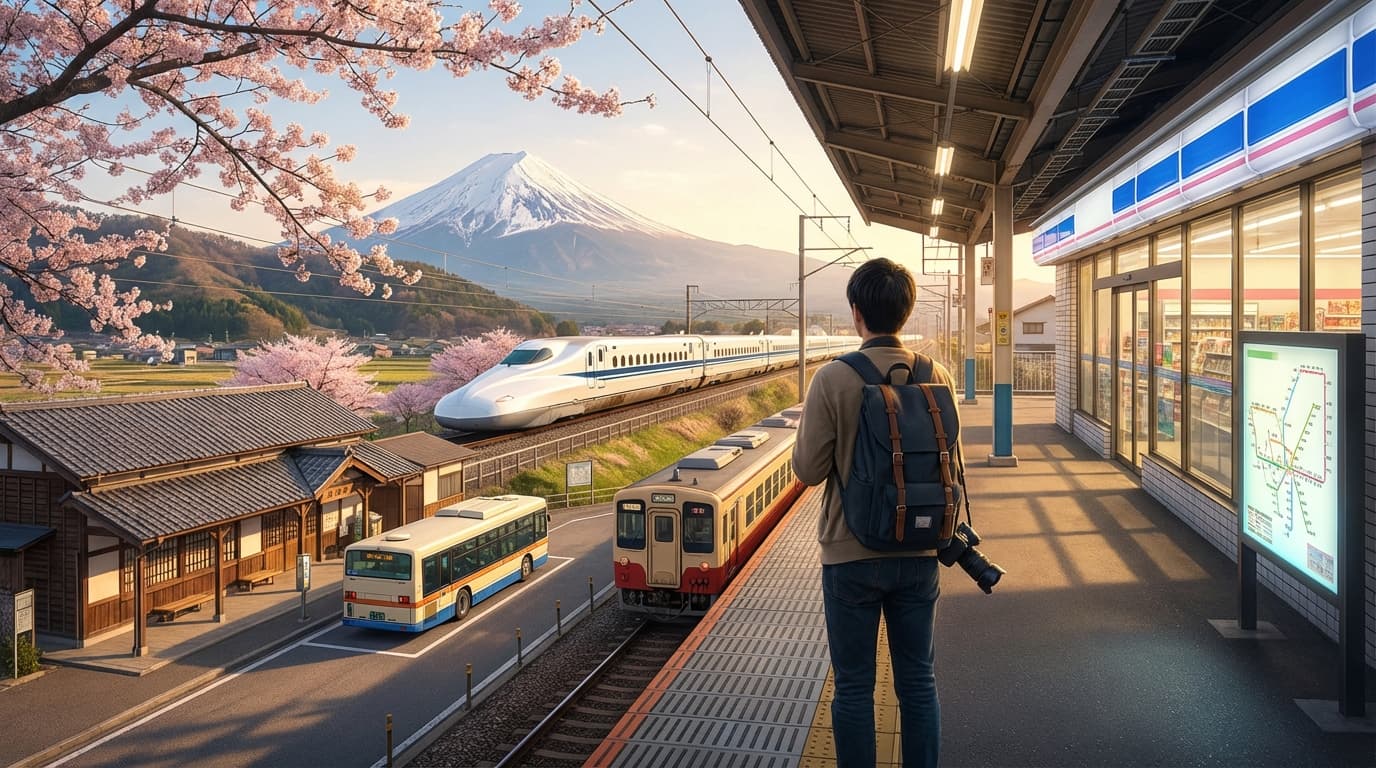
Getting Around Japan: Shinkansen, Buses & Local Trains – Complete Guide
Getting Around Japan: Shinkansen, Buses & Local Trains – Complete Guide
Japan's transportation system is a marvel of efficiency and punctuality—so reliable that average delays on the Shinkansen are measured in seconds, not minutes. Whether you're traveling between Tokyo and Kyoto or navigating the local trains in Osaka, understanding your options will transform your trip from stressful to seamless. After spending years navigating Japan's railways, buses, and subways, we've learned exactly which transport methods work best for different travelers and budgets.
Key Takeaways
| Question | Answer |
|---|---|
| What's the fastest way between major cities? | Shinkansen (bullet train) — Tokyo to Kyoto in 2 hours 15 minutes |
| How much does a Shinkansen ticket cost? | ¥13,320 ($90–100 USD) Tokyo–Kyoto; prices vary by route and class |
| Is a Japan Rail Pass worth it? | Yes, if traveling 4+ intercity routes; 7-day pass costs ¥29,650 ($200 USD) |
| What's the cheapest way to travel? | Long-distance buses; Tokyo–Kyoto from ¥2,000–4,000 ($14–27 USD) |
| How do I pay for local trains? | IC cards (Suica/Pasmo) — buy at stations, load with cash, tap to enter |
| Are trains safe and accessible? | Extremely safe; excellent accessibility for wheelchairs and luggage |
| Should I book in advance? | Shinkansen: yes, especially peak seasons; local trains: no, walk-up tickets fine |
1. Understanding Japan's Transport Hierarchy
Japan's transportation network operates on distinct tiers, each serving different travel distances and budgets. The Shinkansen dominates long-distance travel between regions, while JR local trains and private railways handle medium distances within regions. Buses fill the budget niche and connect smaller towns. Understanding which tier serves your journey is the first step to smart travel planning.
During our two years based in Tokyo, we discovered that most visitors underestimate how affordable and accessible regional travel truly is. The system is so intuitive that even without speaking Japanese, you can confidently navigate from Hokkaido to Kyushu.
The Four Transport Tiers
Tier 1: Shinkansen (Bullet Trains) connect major cities across Japan at speeds up to 320 km/h. These are premium services with reserved seating, onboard food, and punctuality that borders on obsessive. Tier 2 includes JR Limited Express trains (特急, tokkyū) that serve medium distances—typically 200–400 km—at lower speeds and prices than Shinkansen. Tier 3 comprises local trains (普通, futsū) and rapid trains (快速, kaisoku) that stop frequently and serve commuters and short-distance travelers. Tier 4 is long-distance buses, which are slowest but cheapest for intercity travel.
When to Use Each Tier
Use Shinkansen when traveling between major cities (Tokyo–Osaka, Osaka–Hiroshima) and you value time over cost. Limited Express trains work well for regional exploration—say, Kyoto to Kanazawa or Tokyo to Nikko. Local trains are perfect for day trips and exploring within a prefecture. Buses suit budget travelers with flexible schedules and those heading to smaller towns not served by rail.
2. The Shinkansen: Japan's Iconic Bullet Train
The Shinkansen is not just transportation—it's an icon of Japanese engineering and culture. The train arrives with clockwork precision, departs exactly on schedule, and whisks you across the country in comfort. Our first Shinkansen ride from Tokyo to Kyoto remains unforgettable: the moment the train accelerated past Mount Fuji's silhouette felt like a scene from a film.
Shinkansen routes span the country, with the Tokaido line (Tokyo–Osaka–Kyoto) being the busiest and most tourist-friendly. The Sanyo line extends from Osaka to Hiroshima and beyond, while the Tohoku line serves northern regions. Each line operates multiple train types with different speeds and prices.
Shinkansen Ticket Prices and Types
There are three main Shinkansen train types on the Tokaido line, each with different speeds and fares:
- Nozomi trains (fastest, 320 km/h): Tokyo–Kyoto ¥13,320 ($90–100 USD); Tokyo–Osaka ¥13,870 ($94–105 USD). These are the premium option, cutting 15 minutes off travel time compared to Hikari trains.
- Hikari trains (fast, 285 km/h): Tokyo–Kyoto ¥13,320; Tokyo–Osaka ¥13,870. Only slightly slower than Nozomi but same price—choose based on schedule convenience.
- Kodama trains (standard, 220 km/h): Tokyo–Kyoto ¥11,100 ($75–80 USD); Tokyo–Osaka ¥11,100. Slower but notably cheaper, with more frequent stops.
Prices shown are for unreserved ordinary class (自由席, jiyūseki). Reserved seats (指定席, shitei-seki) cost ¥300–500 more. First-class Green Car (グリーン車, gurīn-sha) costs approximately 50% more and includes complimentary beverages and wider seating.
How to Book Shinkansen Tickets
Online booking through Hyperdia (hyperdia.com) or the official JR East website is easiest for English speakers. You can also book through travel agencies or at station ticket offices (みどりの窓口, midori no madoguchi). During peak seasons (Golden Week in late April, Obon in August, New Year holidays), book 1–2 weeks ahead. For off-peak travel, same-day booking is usually fine.
When we visited during cherry blossom season, we learned the hard way that Nozomi trains sell out 10 days in advance. Booking a Kodama train instead saved us ¥2,000 and gave us time to enjoy the views.
Did You Know? The Tokaido Shinkansen has carried over 10 billion passengers since 1964 without a single fatality caused by train operation.
Shinkansen Etiquette and Practical Tips
- Phone calls: Strictly forbidden in ordinary cars; use designated quiet cars (静粛車両, seisyuku-syaryou) for silence.
- Food and drinks: Allowed; many passengers buy ekiben (station bento boxes) before boarding. Vendors also walk through cars selling snacks and drinks.
- Luggage: Store overhead or under seats. Large suitcases fit in designated spaces at car ends.
- Timing: Arrive 15 minutes before departure; trains leave exactly on schedule.
3. Japan Rail Pass: Is It Worth Your Money?
The Japan Rail Pass (JR Pass) is a tourist-only ticket that grants unlimited travel on most JR trains nationwide, including Shinkansen (except Nozomi trains). For international visitors, it can represent extraordinary value—or a waste of money, depending on your itinerary. Understanding the math is crucial.
A 7-day JR Pass costs ¥29,650 ($200 USD) for ordinary class, ¥39,070 ($265 USD) for first class. A 14-day pass is ¥47,250 ($320 USD) ordinary, ¥62,360 ($420 USD) first class. A 21-day pass is ¥61,390 ($415 USD) ordinary, ¥81,870 ($555 USD) first class. These prices are for exchange vouchers purchased outside Japan; prices vary slightly if purchased in Japan.
When the JR Pass Pays for Itself
A single Tokyo–Kyoto Shinkansen ticket costs ¥13,320. If your itinerary includes 4+ intercity Shinkansen or Limited Express journeys, a 7-day pass likely pays for itself. For example: Tokyo–Kyoto (¥13,320) + Kyoto–Hiroshima (¥10,320) + Hiroshima–Tokyo (¥13,320) = ¥37,000 in three journeys. A 7-day pass (¥29,650) saves ¥7,350.
However, if you're spending most of your time in one city (Tokyo or Kyoto) with only one or two regional trips, individual tickets are cheaper. During our time in the Kansai region, we calculated that a 7-day pass made sense only because we were visiting Kyoto, Osaka, Kobe, and Himeji—four separate day trips requiring multiple train journeys.
JR Pass Limitations to Know
- Nozomi trains excluded: You cannot use a JR Pass on the fastest Shinkansen trains. Nozomi is the only Shinkansen type not covered; Hikari and Kodama are included.
- Private railways not included: Many scenic routes and regional trains are operated by private companies (Kintetsu, Odakyu, etc.) and aren't covered.
- Local subways excluded: Tokyo Metro, Osaka Metro, and Kyoto buses require separate IC cards or tickets.
- Activation deadline: You have 30 days to activate your exchange voucher after purchase.
How to Purchase and Activate
Purchase JR Pass exchange vouchers outside Japan through travel agencies or the official JR Pass website (jrpass.com). You cannot buy a JR Pass in Japan as a tourist. Exchange your voucher at JR offices in major cities (Tokyo Station, Kyoto Station, Osaka Station) by presenting your passport. Activation is immediate; you choose your start date at exchange.
Did You Know? The JR Pass was created in 1986 specifically to encourage international tourism and has become one of the most popular tourist purchases in Japan.
Source: Japan Rail Pass Official
4. Local Trains and the IC Card System
For daily travel within cities and regions, local trains are your lifeline. Tokyo's JR Yamanote Line loops the city in 60 minutes. Kyoto's trains connect temples and neighborhoods. Osaka's subway network rivals any major city's. The key to seamless travel is understanding IC cards—rechargeable smart cards that work across most transit systems nationwide.
Suica and Pasmo: Your Transit Passport
Suica (JR-operated) and Pasmo (private railway-operated) are Japan's two main IC cards. In practice, they're interchangeable in most cities. A Suica works on JR trains, subways, and even convenience store vending machines across Japan. Pasmo works similarly on private railways and subways.
How to buy: Visit any JR station ticket office or convenience store (7-Eleven, FamilyMart, Lawson). Purchase a Suica card for ¥2,000 (¥1,500 stored value + ¥500 deposit) or Pasmo for ¥2,070 (¥1,500 stored value + ¥570 deposit). The deposit is refundable when you return the card.
How to use: Tap the card on the reader (読み取り機, yomitoriski) when entering and exiting the station. The fare is automatically deducted. When balance runs low, reload at station machines or convenience stores in increments of ¥1,000–10,000.
During our time navigating Tokyo, we discovered that a single Suica card eliminated the need to buy individual tickets for every journey. Over a week, we took approximately 40 train trips; a Suica made each entry seamless.
Local Train Fares and Examples
Local train fares vary by distance. In Tokyo, a single journey costs ¥150–¥320 ($1–2.20 USD) depending on distance. In Kyoto, fares range ¥220–¥230 per journey. Most visitors find that daily train costs in major cities average ¥1,000–2,000 ($7–14 USD).
- Tokyo JR Yamanote Line: ¥150–¥220 per journey; unlimited travel day pass ¥700 ($4.75 USD)
- Kyoto Bus: ¥230 per journey; day pass ¥700 ($4.75 USD)
- Osaka Metro: ¥220–¥330 per journey; day pass ¥900 ($6 USD)
Navigation Tips for Local Trains
Station signs display English translations in major cities. Download the Hyperdia or Google Maps apps—both show real-time train schedules and platform numbers. When we first arrived in Tokyo, we relied on Google Maps for every journey; within a week, we recognized patterns and navigated intuitively.
Most stations have English signage, but smaller stations may not. Don't hesitate to ask station staff (駅員, ekiin)—they're accustomed to helping foreign travelers and often speak basic English.
5. Long-Distance Buses: The Budget Alternative
If your priority is cost over speed, long-distance buses (高速バス, kousoku basu) offer remarkable value. A Tokyo–Kyoto bus journey costs ¥2,000–4,000 ($14–27 USD) compared to ¥13,320 for Shinkansen. The trade-off is time: the same journey takes 7–8 hours by bus versus 2 hours 15 minutes by train.
Bus Operators and Booking
Major bus operators include Willer Express, Neoplan, and Kyoto Bus. Most offer online booking through their websites or through Hyperdia. Buses typically depart in evening (allowing daytime sightseeing) and arrive early morning, effectively saving a hotel night. Night buses are popular with budget backpackers for this reason.
Typical fares (prices vary seasonally):
- Tokyo–Kyoto: ¥2,500–4,000 ($17–27 USD)
- Tokyo–Osaka: ¥2,000–3,500 ($14–24 USD)
- Osaka–Hiroshima: ¥3,000–5,000 ($20–34 USD)
Bus Comfort and Practical Considerations
Standard buses have reclining seats and onboard toilets. Premium buses offer wider seats and blankets. Buses are generally comfortable for journeys under 8 hours; longer routes can feel cramped. Our experience on a Tokyo–Kyoto night bus was surprisingly pleasant—we slept most of the journey and arrived refreshed.
Buses are ideal for:
- Budget travelers with flexible schedules
- Night travel (save accommodation costs)
- Traveling with large groups (group discounts available)
Buses are not ideal for:
- Travelers with mobility issues (limited accessibility)
- Those with tight schedules
- Passengers who need frequent stops
6. Regional Trains and Limited Express Services
Beyond the Shinkansen, Limited Express trains (特急, tokkyū) serve regional routes with comfort and reasonable fares. These trains are slower than Shinkansen but faster than local trains, making them ideal for day trips and regional exploration.
Popular Limited Express Routes
Tokaido Region: The Odakyu Romance Car (ロマンスカー) runs Tokyo–Hakone in 90 minutes (¥2,940, $20 USD), offering mountain views and onboard dining. The Kintetsu Shimakaze connects Osaka–Nara in 45 minutes (¥1,260, $8.50 USD).
Kansai Region: The Haruka Express connects Kobe–Kyoto in 75 minutes (¥7,500, $50 USD). The Thunderbird Limited Express links Osaka–Kanazawa in 3 hours 30 minutes (¥7,500, $50 USD).
Hokkaido: The Lilac Limited Express runs Sapporo–Asahikawa in 90 minutes (¥7,070, $48 USD).
During our exploration of the Kansai region, we took the Haruka Express from Kyoto to Kobe for a day trip. The train was modern, uncrowded, and offered stunning views of the Kobe coastline.
Booking Limited Express Trains
Most Limited Express trains require seat reservations (included in the fare). Book at station ticket offices or online through Hyperdia. Unlike Shinkansen, Limited Express trains rarely sell out except during peak holidays, so same-day booking is usually fine.
7. Navigating Tokyo's Complex Train System
Tokyo's train system intimidates many first-time visitors—and understandably so. The capital has 13 subway lines, multiple JR lines, and numerous private railways, all color-coded and numbered. Yet after a few days, the system becomes intuitive.
The Essential Lines
JR Yamanote Line (山手線, yamanote-sen): A 35 km loop connecting all major neighborhoods. Trains run every 2–4 minutes. This is the line most visitors rely on for orientation. Riding the full loop takes 60 minutes and costs ¥150–¥220.
Tokyo Metro Marunouchi Line (丸ノ内線): Runs north–south through central Tokyo, connecting Shinjuku, Tokyo Station, and Ginza. Essential for reaching major shopping and business districts.
Tokyo Metro Ginza Line (銀座線): Runs east–west, connecting Shibuya, Ginza, and Asakusa. Perfect for sightseeing.
JR Chuo Line (中央線): Runs east–west, serving Shinjuku, Shibuya, and extending to the western suburbs and Japanese Alps.
When we first arrived in Tokyo, we bought a Suica card and spent our first day riding the Yamanote Line in both directions, getting off at each major station to understand the city's geography. This single investment of time paid dividends for the rest of our stay.
Tokyo Train Etiquette
- Priority seating: Seats marked with pink or blue are reserved for elderly, pregnant, and disabled passengers. Stand if you're young and healthy.
- Crowding: During rush hours (7–9 am, 5–7 pm), trains are packed. Avoid if possible; if not, move toward the center of cars.
- Backpacks: Remove and hold during crowded times to avoid hitting other passengers.
- Eating and drinking: Allowed on most trains except subways; avoid strong-smelling foods.
8. Getting to and From Airports
Japan's major airports—Narita and Haneda in Tokyo, Kansai International in Osaka, Fukuoka, and Sapporo—all have excellent rail connections. Haneda Airport (羽田空港, haneda kuukou) is Tokyo's primary airport and sits just 14 km south of central Tokyo.
Airport Express Trains
Narita Express (N'EX) connects Narita Airport to Tokyo Station (60 minutes, ¥3,070, $21 USD) and Shinjuku (90 minutes, ¥3,070). Trains depart every 30–60 minutes. A JR Pass covers N'EX, making it valuable for pass holders.
Haneda Airport Express (Keikyu Line) connects Haneda to Shimbashi Station (14 minutes, ¥410, $2.80 USD) or Shinagawa Station (13 minutes, ¥410). This is Tokyo's fastest and cheapest airport connection. From Shinagawa, you can connect to Shinkansen for onward travel.
Haruka Express connects Kansai International Airport to Kyoto (75 minutes, ¥3,600, $24 USD) and Osaka (30 minutes, ¥3,600). A JR Pass covers Haruka, making it excellent value for pass holders.
Airport Limousine Buses
For convenience, Airport Limousine buses (エアポートライナー, eapooto rainā) connect airports directly to major hotels. Fares are higher (¥3,000–4,000, $20–27 USD) but eliminate transfers. Booking is available online or at airport information desks.
During our arrival at Haneda, we took the Keikyu Line to Shinagawa (¥410) and caught a Shinkansen to Kyoto from there. The total cost was ¥3,480 ($23.50 USD) versus ¥5,000+ ($34 USD) for a limousine bus—and we saved time by combining connections.
Did You Know? Haneda Airport has become the world's busiest airport by passenger traffic, handling over 85 million passengers annually.
9. Practical Payment Methods and IC Card Management
Beyond IC cards, Japan's transit system accepts several payment methods. Understanding your options ensures smooth travel without confusion.
Payment Options at Ticket Machines
IC cards (Suica, Pasmo, or regional variants) are fastest and work nationwide. Cash is accepted at all ticket machines; machines dispense ¥1,000 notes as change. Credit cards work at some machines in major stations but not all—don't rely on them exclusively.
Mobile payment (Apple Pay, Google Pay) works with Suica on iPhones and Android phones in Japan. Set up before arriving or at a Japanese convenience store. This eliminates the need for a physical card.
Reloading Your IC Card
IC cards run out of value surprisingly quickly—a week of Tokyo travel can consume ¥1,500–2,000 in fares. Reload at:
- Station ticket machines (駅の券売機, eki no kensatsuki)
- Convenience stores (7-Eleven, FamilyMart, Lawson, Ministop)
- Supermarket customer service desks
Reload in ¥1,000 increments. Most machines accept ¥1,000, ¥5,000, and ¥10,000 notes.
Regional IC Cards
Outside major cities, regional IC cards dominate. Kyoto uses ICOCA (¥2,000 initial cost, ¥1,500 stored value). Osaka uses Pitapa or ICOCA. Hiroshima uses PiTaPa. Fortunately, Suica and Pasmo work in most of these cities as well, so purchasing a Suica in Tokyo usually covers your entire trip.
10. Travel Insurance and Accessibility Considerations
Japan's trains are remarkably accessible compared to many countries, but understanding your options ensures comfortable travel.
Wheelchair and Mobility Access
All Shinkansen trains have wheelchair-accessible cars with spacious restrooms. Local trains in major cities (Tokyo, Osaka, Kyoto) have elevators at most stations, though older stations may lack them. Staff at ticket offices can provide accessibility information and assistance.
When booking Shinkansen tickets, inform the station staff of mobility needs. They'll assign wheelchair-accessible cars and may provide boarding assistance. Advance notice (24 hours) ensures smooth service.
Luggage and Large Bags
Japan's trains accommodate luggage well. Shinkansen has overhead racks and floor space at car ends. Local trains have less space; avoid peak hours if traveling with large suitcases. Many travelers use luggage forwarding services (takkyubin) to send suitcases between hotels, traveling with only day packs on trains.
Travel Insurance
While not directly related to transport, travel insurance covering trip delays and cancellations is wise, especially during typhoon season (September–October) when trains occasionally stop. Japan's trains are so reliable that delays are rare, but weather-related disruptions do occur.
Frequently Asked Questions
What's the difference between Suica and Pasmo?
Suica and Pasmo are functionally identical IC cards for transit. Suica is JR-operated; Pasmo is private-railway-operated. Both work on subways, buses, and trains nationwide. Choose whichever is available at your first station—the difference is negligible.
Can I use my JR Pass on the Nozomi Shinkansen?
No. The JR Pass covers Hikari and Kodama Shinkansen but not Nozomi trains. Nozomi is the fastest (320 km/h) but excluded from passes. If you have a JR Pass, book Hikari trains instead—they're only 15 minutes slower and cost the same.
How early should I arrive for Shinkansen departure?
Arrive 15 minutes before departure. Shinkansen departs exactly on schedule—there's no grace period. Unlike airlines, trains don't wait for late passengers.
Are trains in Japan safe for solo travelers?
Yes, absolutely. Japan's trains are among the world's safest. Solo travelers, including women, travel safely on all train types at all hours. Designated women-only cars (女性専用車両, josei senyou-syaryou) operate during rush hours on most lines if you prefer.
What should I do if I miss my Shinkansen?
If you have a reserved ticket, you can exchange it for the next available train of the same class at the ticket office—no additional charge. If you have an unreserved ticket, simply board the next train. JR is remarkably flexible with missed connections.
Can I bring food and drinks on trains?
Yes. Eating and drinking are allowed on Shinkansen and Limited Express trains. Local trains and subways allow drinks but discourage eating. Many travelers buy ekiben (station bento boxes) before boarding Shinkansen—it's a quintessential Japanese travel experience.
How do I know which platform my train departs from?
Station displays (駅の掲示板, eki no keijiban) show platform numbers 10–15 minutes before departure. Announcements in Japanese and English also announce platform changes. Don't worry if you're initially unsure—follow other passengers or ask station staff.
Conclusion
Japan's transportation system is a triumph of efficiency, affordability, and user-friendliness. Whether you choose the speed of the Shinkansen, the value of a JR Pass, the convenience of local trains, or the budget-friendliness of buses, you have options suited to every travel style and budget. The key is understanding your itinerary, calculating costs, and booking strategically.
Start with an IC card (Suica or Pasmo) purchased at your first station—this single decision will streamline your entire trip. For intercity travel, decide between Shinkansen (speed), Limited Express (balance), or buses (budget). If you're planning 4+ intercity journeys, a JR Pass likely pays for itself.
For more detailed planning, explore our Japan Rail Pass guide and Japan travel guide 2026. And remember: Japan's trains run on time, staff are helpful, and getting lost is part of the adventure.
Ready to explore Japan? Start planning your itinerary today, and don't hesitate to reach out if you have questions. Japan's transport system will reward your confidence with seamless, unforgettable journeys.
Sources & References
This article is based on first-hand experience and verified with the following official sources:

Go2Japan Team
Exploring Japan since 2021 | 35+ prefectures visited | Updated monthly
We are a team of travel writers and Japan enthusiasts who explore the country year-round. Our guides are based on first-hand experience, local knowledge, and verified official sources.
More about us →People Also Read
Getting Around Japan: Essential Transport Guide, Routes, and Costs for 2026
Navigate Japan effortlessly with our guide to transport options, key routes, and costs. From Shinkansen to buses, plan your 2026 trip with practical tips.
Japanese Etiquette Guide: 20 Do's and Don'ts
20 essential Japanese etiquette rules for travelers -- from train behavior and onsen rules to temple customs and tipping. What to do, what to avoid, and why it matters.
Japan Rail Pass Guide 2026: Is It Worth It & How to Use It
Complete JR Pass guide for 2026: costs, eligibility, how to buy, and whether it saves money on your Japan trip.

Japan in Peak Season vs Low Season: Honest Comparison
Peak vs low season in Japan: crowds, costs, weather, and festivals compared. Plan smarter with honest pros and cons for each season.
Plan Your Japan Trip
Book hotels, transport, activities, and get connected with an eSIM
Some links are affiliate links. We may earn a commission at no extra cost to you.