Onsen Guide: Japanese Hot Spring Etiquette & Best Spots
Onsen Guide: Japanese Hot Spring Etiquette & Best Spots
Japan sits on the Pacific Ring of Fire. The same geology that produces earthquakes and volcanic mountains also produces over 27,000 geothermal hot spring sources -- the highest density of any country on earth. The ritual of bathing in these mineral-rich waters, the onsen, is woven into Japanese culture at a deep level. It is not a spa amenity. It is a practice with a long history, strict etiquette, and real physical benefits. This guide explains everything you need to know to use an onsen correctly, choose the right facility, and find the best onsen towns in Japan.
What Is an Onsen?
The Japanese government legally defines onsen as hot spring water meeting specific mineral content or temperature standards (at least 25°C at the source). The water may be sulphurous, sodium-chloride rich, acidic, carbonated, or alkaline depending on the volcanic geology of the area -- and each type is associated with different therapeutic properties.
Onsen facilities range widely:
- Soto-yu / public bathhouses in onsen towns: Pay per entry (¥400--800), bring your own or rent towels.
- Ryokan onsen: Private hot spring baths at Japanese inns, included in accommodation. May have communal baths plus smaller private baths (kashikiri or kazoku-buro) bookable by room guests.
- Day-use onsen facilities: Hotel or ryokan baths open to non-guests for a day-use fee (¥1,000--2,500). Common in Hakone and other tourist areas.
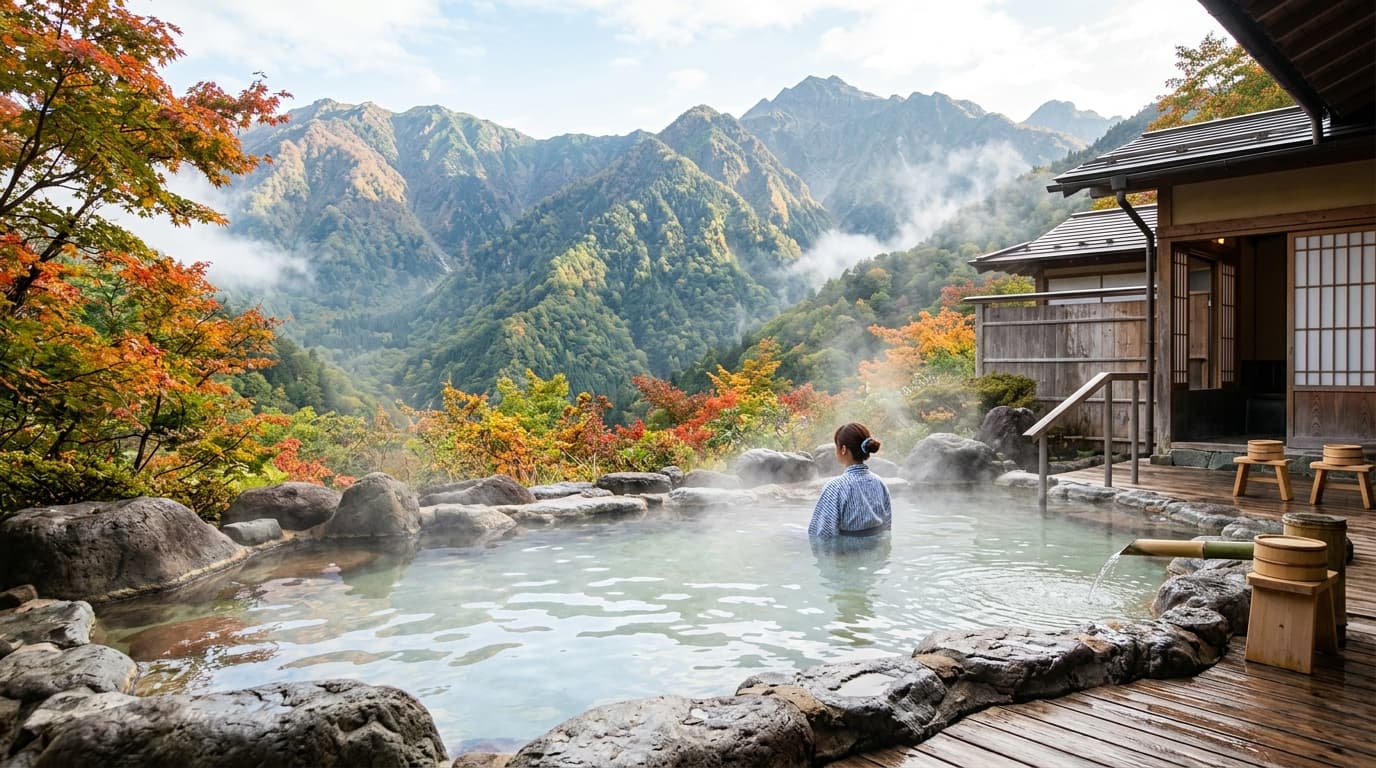
- Rotenburo (outdoor onsen): Open-air baths, often surrounded by forest, mountains, or snow. Among Japan's most memorable experiences -- particularly in winter.
- Mixed-gender onsen (konyoku): Rare and typically found at rustic outdoor facilities. A light cotton yukata or modesty garment may be provided.
Onsen Etiquette: Step by Step
Before You Enter
-
Separate the genders. Most onsen facilities have separate male (blue sign) and female (red sign) bathing areas. The entrance will be clearly marked.
-
Leave everything in the changing room. Undress completely and store your clothes, bag, and belongings in a locker or basket. Your small modesty towel comes with you. Your large towel stays in the changing room.
-
Do not bring your phone into the bathing area. Photography is strictly forbidden in all changing rooms and bathing areas. This is one of the most important rules.
The Pre-Bath Wash
This is the most important step, and the one foreign visitors most often miss.
Along the wall of the bathing room you will find individual shower stations -- a small stool, a handheld shower head, and soap/shampoo. Sit on the stool and wash your entire body thoroughly with soap. Rinse all soap off completely. Wash your hair if you plan to soak your head. This is not optional. The onsen pool water is shared and must be kept clean -- entering without washing first is the equivalent of getting into a clean pool without showering.
After washing, rinse the shower stool and put it back.
Entering the Bath
- Move to the bath slowly and without splashing.
- Ease in gradually. Onsen water can be very hot (38--44°C is common; some reach 48°C). If it feels too hot, sit on the edge and let your legs acclimate first.
- Your small modesty towel must not enter the water. Fold it and place it on the edge of the bath or on your head (the traditional Japanese style).
- Do not swim, splash, or exercise vigorously. Onsen bathing is about stillness and relaxation.
- Avoid putting your face underwater.
During the Soak
- Keep your voice low. Onsen spaces are quiet by default.
- It is fine to close your eyes and simply soak in silence.
- Move between different pools if the facility has multiple baths (different temperatures, indoor/outdoor, different mineral compositions).
- Drink water if provided -- hot spring water dehydrates you faster than you expect.
After the Bath
- Pat dry before leaving the bathing area so you do not drip water all over the changing room floor.
- Moisturize if you have sensitive skin -- sulphur-heavy onsen can dry skin significantly.
- Do not eat a large meal immediately before bathing. Wait at least 30 minutes after eating.
- Avoid intense physical activity or alcohol immediately after a long soak.
Tattoo Policies: What to Know
Tattoo restrictions at Japanese onsen stem from historical policies excluding yakuza (organized crime) members, who were often heavily tattooed. Many traditional facilities still enforce blanket bans on tattooed guests.
Current situation in 2026:
- Many onsen, particularly in tourist areas, now welcome tattooed guests or are revising policies.
- Kinosaki Onsen (Hyogo Prefecture) has officially welcomed tattooed guests at all seven public baths since 2023 -- a landmark shift.
- Beppu has a growing number of tattoo-friendly facilities.
- Many ryokan offer private baths (kashikiri) bookable for 30--60 minutes, which sidestep the shared bath policy entirely.
- Tattoo seals/stickers: Waterproof skin-colored adhesive patches can cover small tattoos for the duration of a soak. Some facilities permit this; others do not.
Always check directly with the facility before visiting. A simple email inquiry -- "Do you allow guests with tattoos?" -- usually gets a clear answer.
Best Onsen Towns in Japan
1. Kusatsu Onsen (Gunma Prefecture)
Japan's most celebrated hot spring town, ranked #1 in the annual "Japan's Top 100 Onsen" survey for 22 consecutive years. Set in the mountains of Gunma at 1,200 meters, Kusatsu is famous for its intensely acidic hot spring water -- the yubatake ("hot water field") at the town center is a large outdoor wooden structure where the water is cooled and circulated before distribution. The yumomi ceremony, where women in traditional dress cool the water with long wooden paddles, is performed multiple times daily.
Water type: Highly acidic (pH ~2), known for antibacterial properties. Temperature: Very hot -- 50°C+ at source. Getting there: From Tokyo, bus from Shinjuku or JR train to Naganohara-Kusatsuguchistation then bus. About 3--4 hours total. Best time: Winter (December--March) -- soaking in hot spring water while surrounded by deep snow is exceptional.
2. Hakone Onsen (Kanagawa Prefecture)
The most accessible major onsen area from Tokyo, 85 minutes by Odakyu Romancecar. Hakone is a collection of small hot spring towns spread across a volcanic valley, with Mt. Fuji views and the Hakone Open-Air Museum as additional draws. Many ryokan have both indoor and outdoor baths. Day-use facilities are widely available for ¥1,000--2,500.
Water type: Sulfate, sodium chloride; varies by area. Getting there: Odakyu Romancecar from Shinjuku (85 min, ¥2,470). Hakone Free Pass covers all local transport. Best time: Autumn for foliage; winter for Fuji views. Spring brings plum and cherry blossoms. Day-use tip: Hakone Kowakien Yunessun has outdoor onsen with a pool-park concept (swimsuit permitted in the main pool area, traditional naked baths separate).
3. Kinosaki Onsen (Hyogo Prefecture)
A traditional onsen town on the Sea of Japan coast, 160km west of Kyoto. Kinosaki is organized around seven separate public bath houses (soto-yu) that guests rotate between while wearing yukata and wooden geta sandals -- a classic onsen-town experience that is largely unchanged for centuries. The willow-lined canal at the town center is particularly atmospheric at night with paper lanterns lit along the water.
Water type: Sodium chloride; smooth, skin-softening water. Getting there: JR limited express Kinosaki from Osaka or Kyoto (about 2.5--3 hours). Notable: One of Japan's most tattoo-friendly onsen towns -- all seven public baths officially accept tattooed guests. Best time: Winter (snow on the willows and the town's historic rooftops is iconic); autumn foliage is also beautiful.
4. Beppu (Oita Prefecture, Kyushu)
Japan's most prolific hot spring city by volume of water -- Beppu produces more hot spring water than anywhere else on earth. The famous "Hells of Beppu" (Beppu Jigoku) are seven striking hot spring features including a blood-red pool (Chinoike Jigoku) and a vivid cobalt-blue one (Umi Jigoku). These are for viewing rather than bathing. For actual soaking, Beppu has dozens of public baths (hyotan onsen, takegawara onsen) ranging from traditional to elaborate.
Water type: Varies wildly by well -- sodium chloride, sulfur, alum, and radioactive (mildly -- Radon type) springs all found within the city. Getting there: Fly from Tokyo or Osaka to Oita Airport, then 45 minutes by bus. Or take the JR Sonic Limited Express from Fukuoka (90 min). Best time: Year-round; Beppu's hot spring volumes are consistent in all seasons.
5. Gero Onsen (Gifu Prefecture)
Ranked second in the Kanko Keizai Shimbun's 2025 Top 100 Onsen. Set along the Hida River in central Gifu Prefecture, Gero is a more modest-scale onsen town with smooth alkaline water (some of Japan's best for skin). Ryokan are concentrated along the riverside and most have beautiful outdoor baths looking over the river.
Water type: Sodium bicarbonate; known as "bijin-no-yu" (beautiful skin water) for its softening effect. Getting there: JR Hida Limited Express from Nagoya (80 min) or Takayama (45 min). Best time: Autumn for the valley foliage; winter for a quieter, atmospheric experience.
6. Dogo Onsen (Matsuyama, Ehime Prefecture -- Shikoku)
One of Japan's oldest hot spring facilities, with a history of approximately 3,000 years. The ornate three-story Dogo Onsen Honkan building, completed in 1894, is a registered National Important Cultural Property and reportedly inspired the bathhouse in Miyazaki's Spirited Away. The main hall is undergoing restoration through 2025--2027, but the adjacent Asuka-no-Yu facility is fully open.
Water type: Sodium bicarbonate; mild, skin-friendly. Getting there: From Matsuyama, take the retro Botchan Train (tram) to Dogo Onsen stop (15 min from the station). Best time: Spring (the local Matsuyama Castle and Iyo Park cherry blossoms complement a visit nicely).
Ryokan Onsen vs. Public Bath Houses
Ryokan (traditional Japanese inn): A full ryokan stay typically includes room, dinner, and breakfast, with onsen access -- private room baths or communal baths. Prices start at ¥12,000--15,000 per person for entry-level ryokan in areas like Hakone or Gero, and rise substantially for premium establishments. This is an immersive cultural experience -- sleeping on futons, wearing yukata, eating a formal kaiseki dinner.
Public bath houses (soto-yu): Pay per entry, usually ¥400--800. Bring or rent towels. These are the baths used daily by local residents and are often more atmospheric -- older facilities with wooden architecture, simple mineral pools, and no frills.
Day-use facility: Many ryokan and onsen hotels offer their baths for day use, sometimes including a meal package. Usually ¥2,000--5,000 per person.
Types of Onsen Water and Their Properties
| Water Type | Properties | Notable Location |
|---|---|---|
| Sulfur (Iouka) | Yellow tint, distinctive smell, skin-softening | Kusatsu, Noboribetsu |
| Sodium chloride (Enka Natrium) | Salty, warm-retaining after bath | Kinosaki, Atami |
| Acidic (Sansei) | Antibacterial, very hot at source | Kusatsu, Nyuto Onsen |
| Sodium bicarbonate (Tansan) | Alkaline, smooth, good for skin | Gero, Dogo |
| Iron (Tetsusui) | Reddish-brown tint, warming | Various in Tohoku |
| Simple thermal | Clear, mild, widely accessible | Most facilities |
First-Timer Summary
- Enter the correct gendered bath.
- Shower thoroughly at the wash station before touching the bath.
- Enter slowly -- the water is genuinely hot.
- Small towel on the edge or on your head. Never in the water.
- No phones, no photos, no loud talk.
- Stay hydrated. Soak in intervals rather than one long session.
- Pat dry before leaving the bathing room.
Bathing in a Japanese onsen, especially in a rotenburo with mountain or forest views on a cold evening, is one of the experiences that stays with travelers long after they return home. The ritual and the setting combine into something genuinely unlike anything else.
For more on planning a trip that includes onsen towns, see our Hakone day trip guide and Japanese etiquette overview.
Sources & References
This article is based on first-hand experience and verified with the following official sources:

Go2Japan Team
Exploring Japan since 2021 | 35+ prefectures visited | Updated monthly
We are a team of travel writers and Japan enthusiasts who explore the country year-round. Our guides are based on first-hand experience, local knowledge, and verified official sources.
More about us →People Also Read
Japanese Etiquette Guide: 20 Do's and Don'ts
20 essential Japanese etiquette rules for travelers -- from train behavior and onsen rules to temple customs and tipping. What to do, what to avoid, and why it matters.

Japan eSIM and Internet Guide for Travelers: Complete 2026 Guide
Complete guide to staying connected in Japan: eSIM options, SIM cards, WiFi, costs, and setup steps for travelers.

Japan Visa Requirements 2026: Complete Tourist Guide
Complete 2026 guide to Japan visa requirements for tourists. Visa-free entry, tourist visas, eVisas, costs, and step-by-step application process.

Japan Coast Guide: Beach Towns, Islands and Routes
Explore Japan's best beaches, islands, and coastal towns. Island guides, activities, accommodation, and routes for every traveler.
Plan Your Japan Trip
Book hotels, transport, activities, and get connected with an eSIM
Some links are affiliate links. We may earn a commission at no extra cost to you.