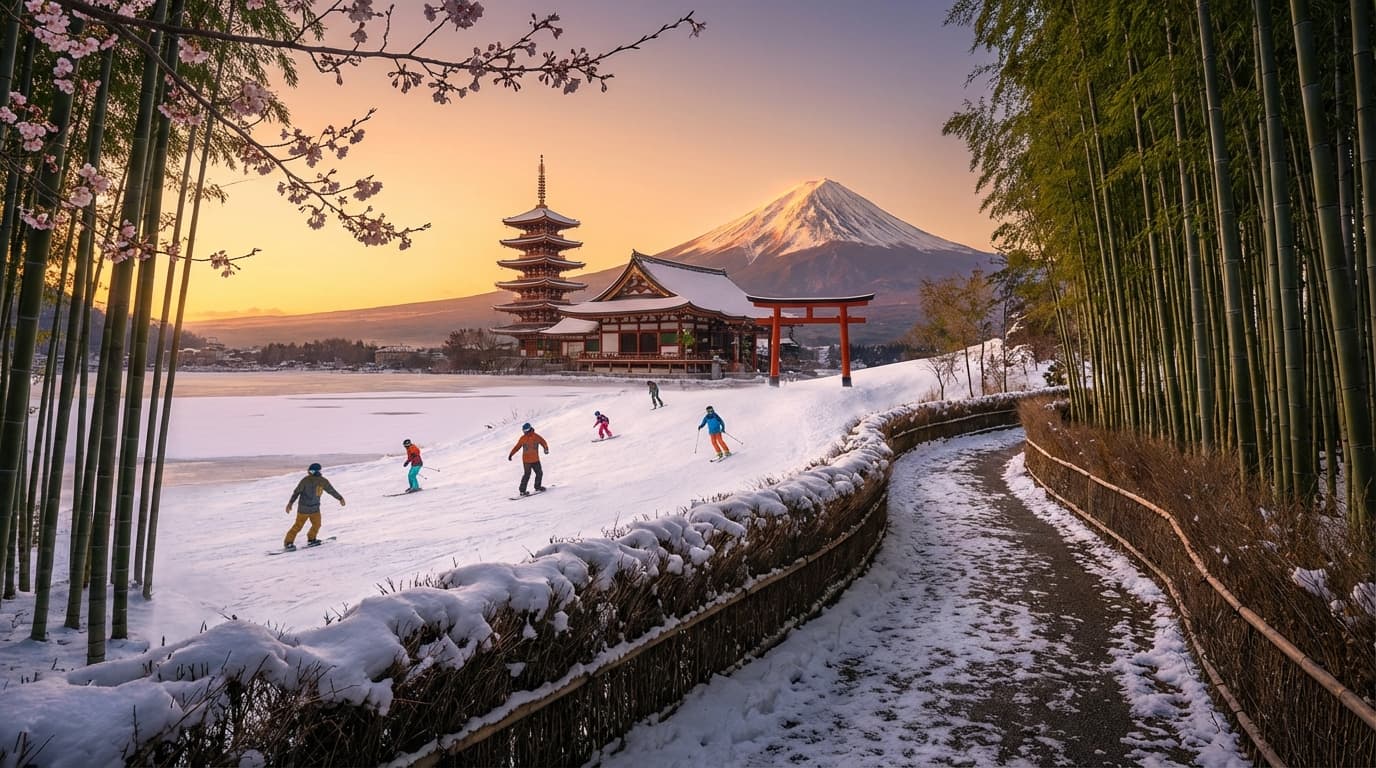
Skiing and Snowboarding in Japan: Niseko, Hakuba & Beyond
Japan's skiing and snowboarding scene has exploded over the past decade, transforming the country into one of Asia's premier winter sports destinations. When we explored the snow-covered peaks of Hokkaido and the Japanese Alps, we discovered world-class powder, modern lift systems, and a uniquely Japanese hospitality that sets these resorts apart from their North American and European counterparts.
Key Takeaways
| Question | Answer |
|---|---|
| What is the best time to visit? | December to March, with peak powder season January–February |
| How much does it cost? | Day passes: ¥6,000–¥9,000 ($40–$60 USD); lessons ¥5,000–¥10,000 ($33–$67 USD) |
| How do I get there? | Fly to Tokyo or Sapporo, then train/bus to resort towns |
| Is it safe? | Yes—excellent avalanche control, well-maintained slopes, English signage improving |
| What should I book in advance? | Accommodation (especially Dec–Feb), lessons, and lift passes during peak season |
| Which resort for beginners? | Niseko or Furano offer gentler terrain and excellent instruction |
| Which resort for experts? | Hakuba Valley and Nagano resorts offer challenging backcountry access |
1. Why Japan's Ski Resorts Are Worth Your Time
Japan's winter sports destinations have earned international recognition for consistent snowfall, exceptional powder quality, and a level of service that feels distinctly Japanese. During our time in Hokkaido, we experienced firsthand why international skiers and snowboarders make the pilgrimage to these mountains.
The Japanese Alps and Hokkaido receive some of the heaviest snowfall in the world—up to 15 meters annually in certain areas. This isn't just quantity; the snow quality is exceptional. The combination of cold Siberian air and moisture from the Sea of Japan creates light, dry powder that skiers and snowboarders dream about. Unlike the heavy, wet snow common in North America's Pacific Northwest, Japanese powder stays fluffy and forgiving.
The Powder Advantage
What makes Japanese resorts unique isn't just the snow—it's the philosophy behind them. Most resorts prioritize grooming, safety, and accessibility over extreme terrain. This means families and intermediate riders can enjoy excellent conditions without feeling overwhelmed. When we visited Niseko in January, we found perfectly groomed runs alongside untracked powder fields, all within easy access of the base.
Cultural Experience Beyond the Slopes
Unlike purely commercial ski destinations, Japanese resorts integrate local culture seamlessly. After a day on the slopes, you'll find onsen (hot springs), traditional kaiseki dinners, and small villages with authentic character. This blend of world-class skiing and cultural immersion is rare globally.
2. Niseko: Japan's Premier International Resort
Niseko sits on the northern island of Hokkaido and has become the most famous ski destination in Japan, particularly among international visitors. The resort combines excellent snow conditions, modern infrastructure, and a cosmopolitan atmosphere that attracts skiers from Australia, North America, and Europe.
Niseko's main appeal is its consistency. The resort receives an average of 15 meters of snow annually, with the season running from late November through April. The terrain is well-distributed across ability levels, making it ideal for mixed-skill groups. When our team spent a week there in February, we found fresh powder on at least three of the seven days—an exceptional track record.
Niseko's Four Interconnected Mountains
The Niseko United area comprises four ski fields: Niseko Village, Niseko Annupuri, Grand Hirafu, and Hanazono. A single lift pass covers all four mountains, offering 61 courses across 1,308 hectares. This interconnected system means you won't get bored, even on a week-long visit.
- Grand Hirafu: The largest and most developed mountain, with excellent intermediate terrain and modern gondolas
- Niseko Village: More exclusive, with a luxury resort village and excellent beginner-to-intermediate runs
- Annupuri: Quieter than Hirafu, with good tree skiing and backcountry access
- Hanazono: The smallest but increasingly popular, with a relaxed vibe and good powder stashes
Niseko Costs & Booking
Day passes at Niseko cost approximately ¥7,500–¥9,000 ($50–$60 USD) depending on the season. Multi-day passes offer savings: a 5-day pass runs around ¥33,000 ($220 USD). Accommodation ranges dramatically—budget hostels start at ¥3,000–¥5,000 per night, while luxury chalets exceed ¥100,000. Mid-range hotels cluster around ¥8,000–¥15,000 per night.
Pro Tip: Book accommodation 2–3 months in advance for December–February travel. Niseko's popularity means rooms fill quickly, and prices spike during school holidays (late December and early January).
3. Hakuba Valley: The Japanese Alps' Powerhouse
Hakuba Valley sits in Nagano Prefecture, nestled in the Japanese Alps, and offers a completely different experience from Hokkaido's Niseko. While Niseko caters to international tourists and families, Hakuba Valley feels more authentically Japanese and appeals to advanced riders seeking challenging terrain.
The valley comprises nine interconnected ski areas, with Hakuba 47 and Cortina being the largest. The terrain is steeper and more varied than Niseko, with excellent off-piste opportunities and backcountry access. During our visit in March, we found the spring conditions ideal for exploring tree runs and couloirs that would be inaccessible earlier in the season.
Hakuba's Terrain & Riding Style
Hakuba Valley excels for intermediate-to-expert riders. The mountains offer everything from groomed cruisers to steep couloirs and challenging tree skiing. Backcountry access is more developed here than at Niseko, with several peaks offering guided off-piste tours. The valley's higher elevation (base elevations around 800m, peaks at 2,000m+) means more consistent snow quality later into spring.
Hakuba Costs & Accessibility
Day passes at Hakuba's main resorts cost ¥6,500–¥8,000 ($43–$53 USD). Multi-day passes are slightly cheaper than Niseko, reflecting the valley's slightly less touristy positioning. Accommodation is more affordable than Niseko: budget options start at ¥2,500–¥4,000 per night, with mid-range hotels at ¥6,000–¥12,000.
The valley is accessible via train from Tokyo (approximately 5–6 hours) or Nagano (1.5 hours). This proximity to Tokyo makes it popular for weekend trips, though this also means crowds on Saturdays and Sundays.
Did You Know? Hakuba hosted the 1998 Winter Olympics alpine skiing events, and the infrastructure built for those games remains among Japan's best.
4. Beyond the Big Two: Furano, Shikotsu-Toya & Hidden Gems
While Niseko and Hakuba dominate international attention, Japan's ski scene extends far beyond these two resorts. Furano, also in Hokkaido, offers excellent powder and a more relaxed, less crowded atmosphere than Niseko. The resort receives similar snowfall and offers comparable terrain, but with a distinctly local feel.
When we explored Furano in early February, we found excellent conditions and significantly shorter lift lines than Niseko. The trade-off is less English signage and fewer English-speaking staff, though this is improving. Day passes cost approximately ¥6,000–¥7,500 ($40–$50 USD), and accommodation is notably cheaper than Niseko.
Emerging Alternatives Worth Considering
Shikotsu-Toya near Sapporo offers excellent powder and proximity to the city—ideal if you want to combine skiing with urban exploration. Myoko Kogen in Niigata Prefecture receives some of Japan's heaviest snowfall and appeals to serious powder hounds willing to venture off the beaten path. Naeba in Niigata is easily accessible from Tokyo and offers good terrain for all levels.
- Best for Families: Furano offers gentler terrain, shorter lift lines, and a village atmosphere that feels less hectic than Niseko
- Best for Backcountry: Hakuba Valley and Myoko Kogen offer the most developed off-piste infrastructure and guided touring options
- Best for Proximity to Tokyo: Naeba and Gala Yuzawa are accessible via Shinkansen (bullet train) in under 2 hours
- Best for Budget Travelers: Furano and Shikotsu-Toya offer significantly lower accommodation costs than Niseko
5. Lesson & Instruction Quality: What to Expect
Japanese ski schools have earned a reputation for excellent instruction, particularly for beginners and intermediate riders. The teaching methodology emphasizes patience, clear progression, and small group sizes. During our time at Niseko, we observed instructors working with groups of 4–6 people, ensuring individual attention while maintaining group cohesion.
Finding & Booking Lessons
Most major resorts offer lessons in English, though availability varies. Niseko has the most extensive English-language instruction, with schools offering everything from group lessons (¥5,000–¥7,000 per half-day) to private instruction (¥8,000–¥15,000 per hour). Hakuba offers fewer English options, but several schools provide instruction in English, French, and other languages.
Instructor Expertise & Specialization
Japanese instructors tend to specialize in specific areas—some focus on technique refinement for intermediate riders, others on powder skiing or backcountry safety. When booking, specify your goals and ability level. If you're interested in off-piste skiing, request an instructor with backcountry experience and avalanche training.
Pro Tip: Book lessons at least one week in advance during peak season. Popular instructors fill up quickly, and booking ahead ensures you get someone who matches your goals and language preferences.
6. Comparing Resort Infrastructure & Amenities
Japan's ski resorts have invested heavily in modern lift systems, making them efficient and user-friendly. Niseko and Hakuba both feature high-speed gondolas, chairlifts, and drag lifts that minimize wait times even during peak periods. When we visited during school holidays (when crowds are heaviest), average lift wait times remained under 10 minutes.
Accommodation & Village Amenities
Niseko offers the most developed resort village infrastructure. The area features luxury hotels, mid-range lodges, hostels, and vacation rentals. Restaurants range from casual ramen shops to Michelin-starred establishments. Nightlife is vibrant, with numerous bars and clubs catering to international visitors.
Hakuba Valley feels more authentically Japanese. Accommodation is more varied—traditional ryokans, modern hotels, and family-run guesthouses. Dining emphasizes local cuisine: soba, ramen, and regional specialties. The atmosphere is more relaxed and less party-focused than Niseko.
| Resort | Best For | Lift Pass (Day) | Accommodation Range | Vibe |
|---|---|---|---|---|
| Niseko | International visitors, families, luxury seekers | ¥7,500–¥9,000 | ¥3,000–¥100,000+ | Cosmopolitan, busy |
| Hakuba Valley | Advanced riders, backcountry enthusiasts, Japanese experience | ¥6,500–¥8,000 | ¥2,500–¥20,000 | Authentic, relaxed |
| Furano | Budget travelers, powder seekers, families | ¥6,000–¥7,500 | ¥2,000–¥12,000 | Local, quiet |
| Naeba | Tokyo day-trippers, intermediate riders | ¥6,500–¥8,000 | ¥5,000–¥15,000 | Accessible, mixed |
7. Season Planning: When to Go & What to Expect
Japan's ski season runs from late November through April, but conditions vary significantly by month. December offers early-season snow and fewer crowds, though conditions can be variable. January and February represent peak season—consistent powder, fully open terrain, but also maximum crowds and highest prices. March and April bring spring conditions: warmer days, firmer mornings, and increasingly slushy afternoons.
Monthly Breakdown & Recommendations
November–December: Early season, variable conditions, lower prices, fewer crowds. Ideal for budget-conscious travelers and those seeking solitude.
January–February: Peak powder season, consistent snow, full terrain access, maximum crowds, highest prices. Book 3+ months in advance.
March–April: Spring conditions, warmer weather, excellent for afternoon skiing, fewer crowds than January–February. Accommodation prices drop 20–30%.
When we visited in late March, we found excellent morning conditions on groomed runs, with afternoons transitioning to spring snow. The trade-off was shorter days and some terrain closures due to warming, but prices were significantly lower than peak season.
Did You Know? Japan's ski resorts receive an average of 10–15 meters of snow annually, with some areas receiving over 18 meters. This rivals some of North America's snowiest resorts.
8. Getting There: Transportation & Logistics
From Tokyo: Most visitors fly into Narita or Haneda Airport. From Tokyo, reaching Niseko requires approximately 8–10 hours: a 2-hour flight to Sapporo (New Chitose Airport) plus 90 minutes by bus or car to Niseko. Alternatively, take the Shinkansen to Aomori (3.5 hours) then bus to Niseko (2 hours).
From Tokyo to Hakuba: The Shinkansen offers a scenic route—take the train to Nagano (approximately 1.5 hours), then bus or train to Hakuba (another 1.5 hours). Total travel time is roughly 3–4 hours, making it ideal for weekend trips.
Getting Around Japan: The Japan Rail Pass is excellent value if you're combining skiing with other destinations. A 7-day pass costs approximately ¥29,650 ($200 USD) and covers unlimited train travel nationwide.
Driving vs. Public Transport
Renting a car offers flexibility but requires an International Driving Permit and familiarity with Japanese road signs. During winter, mountain roads require snow tires and chains—additional rental costs. Public transport (trains and buses) is reliable, though less flexible. For most visitors, we recommend public transport to resorts, then relying on shuttle buses and local transport once there.
9. Equipment Rental, Lessons & Local Services
All major resorts offer equipment rental on-site. Quality varies—budget rental shops charge ¥3,000–¥5,000 daily for skis or snowboards, while premium shops offering newer equipment cost ¥6,000–¥8,000. If you're staying multiple days, multi-day rental discounts apply.
Rental Quality & Recommendations
Niseko has numerous rental shops, including international brands and local operators. Quality is generally excellent, and shops are accustomed to international customers. Hakuba has fewer options, but quality remains high. Smaller resorts may have limited selection—if visiting Furano or Myoko, consider renting in the nearest town rather than at the resort.
Pro Tip: Bring your own boots if possible. Rental boots are often uncomfortable for full-day skiing, and Japanese sizing can be unpredictable. If you must rent boots, arrive early to try multiple pairs.
Guides & Backcountry Services
For backcountry skiing, hire a certified guide. Niseko has several guide services offering off-piste tours (¥15,000–¥25,000 per day). Hakuba Valley has more extensive backcountry infrastructure, with multiple guide services specializing in avalanche-safe touring. Guides are essential for safety and for accessing the best terrain.
10. Practical Tips & Common Mistakes to Avoid
After extensive time in Japan's ski resorts, we've identified several mistakes visitors commonly make. Booking too late is the most significant—accommodation in Niseko during peak season fills 2–3 months in advance. Underestimating travel time is another frequent error; many visitors don't account for the time required to reach remote resorts from major cities.
Common Pitfalls & Solutions
-
Mistake: Assuming all resorts have English signage and staff. Solution: Larger resorts (Niseko, Hakuba) have good English support, but smaller resorts don't. Download offline maps and translation apps.
-
Mistake: Not checking avalanche forecasts or weather before heading to backcountry areas. Solution: Check daily forecasts, hire certified guides, and take avalanche safety courses if planning serious off-piste skiing.
-
Mistake: Underestimating costs. Solution: Budget ¥10,000–¥15,000 daily for lift passes, lessons, and meals. Accommodation can range from ¥2,000 to ¥100,000+ depending on your preferences.
-
Mistake: Visiting during school holidays without advance booking. Solution: Plan around Japanese school holidays (late December, early January, late March–early April) or book 3+ months ahead.
-
Mistake: Not trying onsen after skiing. Solution: Most resorts have onsen facilities—soaking in hot springs after a day on the slopes is quintessentially Japanese and excellent for recovery.
Pro Tip: Learn basic Japanese phrases—"arigatou gozaimasu" (thank you very much) and "sumimasen" (excuse me) go a long way with staff and locals. Resorts appreciate the effort, and it enhances your experience.
Frequently Asked Questions
What's the difference between Niseko and Hakuba?
Niseko is larger, more international, and better for families and beginners. Hakuba Valley offers more challenging terrain, better backcountry access, and a more authentically Japanese experience. Niseko has more English support; Hakuba requires more Japanese language skills or translation apps.
Do I need to speak Japanese to ski in Japan?
No, but it helps. Niseko has extensive English signage and English-speaking staff. Hakuba has less English support but is manageable with translation apps and basic phrases. Smaller resorts require more Japanese language ability or hiring a guide who speaks English.
What's the best time to visit for powder?
January and February offer the most consistent powder and fully open terrain, but also the highest prices and largest crowds. Late December and March offer excellent conditions with fewer crowds and lower prices—ideal if you can be flexible.
How much should I budget for a week-long ski trip?
Budget ¥80,000–¥150,000 ($530–$1,000 USD) for accommodation, ¥35,000–¥50,000 ($230–$330 USD) for lift passes, ¥20,000–¥30,000 ($130–$200 USD) for meals, and ¥10,000–¥20,000 ($65–$130 USD) for lessons or guides. Total: approximately ¥145,000–¥250,000 ($960–$1,660 USD) for a week.
Can I ski in Japan if I'm a beginner?
Absolutely. Niseko and Furano have excellent beginner terrain and English-speaking instructors. Both resorts offer progression-focused lessons and gentle slopes that build confidence quickly.
Is backcountry skiing safe in Japan?
Yes, with proper precautions. Avalanche risk exists, particularly in certain areas. Always hire certified guides, check daily avalanche forecasts, and take avalanche safety courses. Japanese guides are highly trained and take safety seriously.
Conclusion
Skiing and snowboarding in Japan offers a unique combination of world-class snow, modern infrastructure, and authentic cultural experiences. Whether you choose the cosmopolitan energy of Niseko, the challenging terrain of Hakuba Valley, or the quiet powder of Furano, Japan's resorts deliver exceptional value and unforgettable experiences.
The key to a successful trip is planning ahead—book accommodation 2–3 months in advance for peak season, arrange lessons early, and consider visiting during shoulder season (December or March–April) for better prices and fewer crowds. Combine your skiing with exploration of nearby cities like Sapporo or Nagano, and you'll create a trip that balances world-class winter sports with authentic Japanese culture.
For more information on planning your Japan ski trip, visit our Japan Travel Guide 2026 or check our practical information section for visa requirements, transportation options, and travel insurance recommendations.
Sources & References
This article is based on first-hand experience and verified with the following official sources:

Go2Japan Team
Exploring Japan since 2021 | 35+ prefectures visited | Updated monthly
We are a team of travel writers and Japan enthusiasts who explore the country year-round. Our guides are based on first-hand experience, local knowledge, and verified official sources.
More about us →People Also Read

Japan in Peak Season vs Low Season: Honest Comparison
Peak vs low season in Japan: crowds, costs, weather, and festivals compared. Plan smarter with honest pros and cons for each season.

Best Beach Destinations in Japan for Different Travel Styles
Discover Japan's best beach islands for every traveler. From party hotspots to quiet retreats, find your perfect coastal escape.

What to Eat in Japan: Local Food Guide for Travelers
Discover what to eat in Japan with our comprehensive local food guide. Learn about regional dishes, where to find the best versions, and how to order like a local.

Japan Street Food and Markets: What to Try First
Discover Japan's best street food and markets. Learn what to try first, where to find them, and how to order like a local.
Plan Your Japan Trip
Book hotels, transport, activities, and get connected with an eSIM
Some links are affiliate links. We may earn a commission at no extra cost to you.