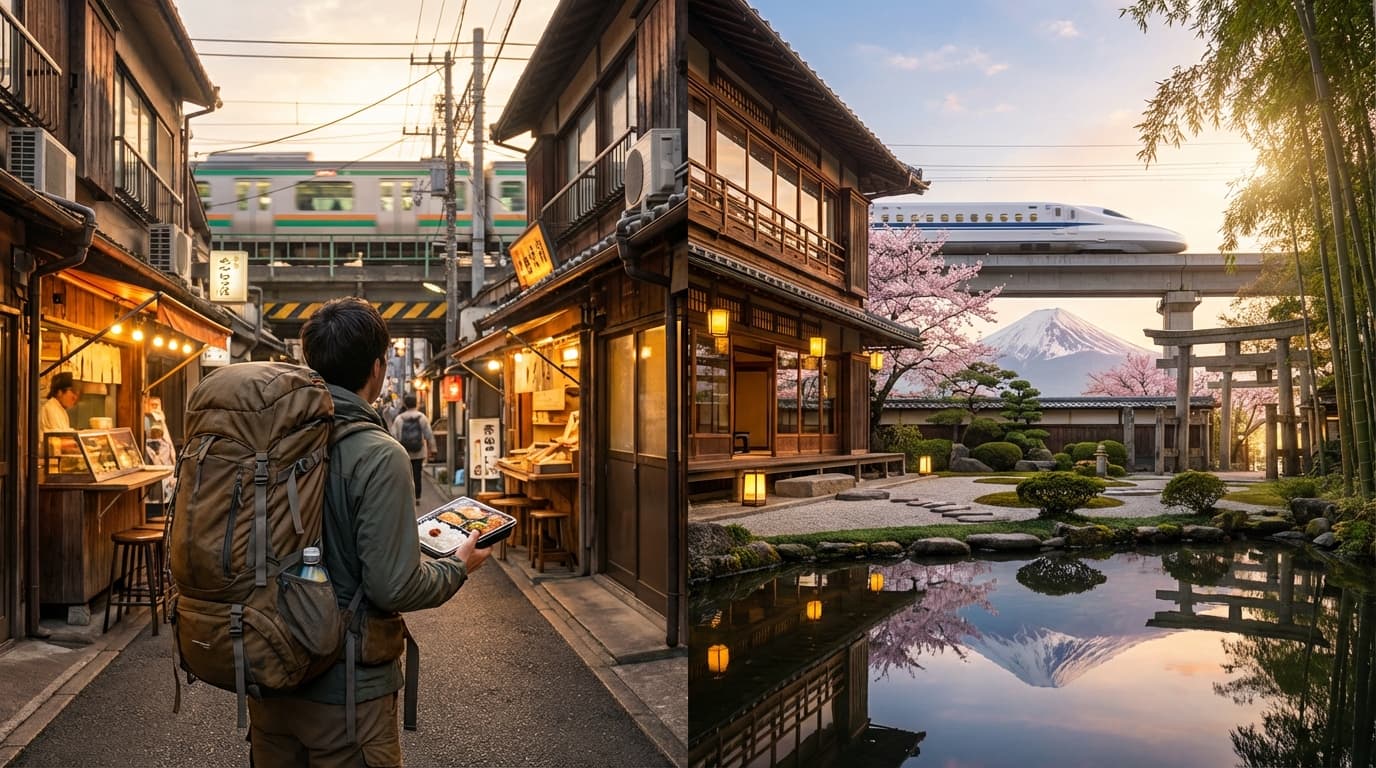
Japan Budget vs Luxury Travel: What's Worth Splurging On
After two years living in Tokyo and exploring everything from the temples of Kyoto to the hiking trails of the Japanese Alps, our team has learned one crucial truth: Japan budget vs luxury travel isn't about choosing one or the other—it's about knowing exactly where your money goes and making intentional decisions. You can eat like royalty for ¥800 ($5.50 USD) or spend ¥8,000 ($55 USD) on the same meal, depending on where you sit.
This guide breaks down real costs, reveals where budget travelers genuinely save money, and shows you where splurging transforms your experience from good to unforgettable.
Key Takeaways
| Question | Answer |
|---|---|
| What's the daily budget range? | Budget: ¥4,000–6,000/day ($27–41 USD); Mid-range: ¥8,000–12,000/day ($55–82 USD); Luxury: ¥20,000+/day ($137+ USD) |
| Where should I save money? | Street food, convenience stores, public transport, free attractions, budget hotels |
| Where is splurging worth it? | Multi-day experiences (hiking, hot springs), Michelin-starred meals, JR Pass for intercity travel, premium hotels in key cities |
| Is Japan actually expensive? | Not compared to Western Europe or Australia; very affordable if you eat local and use public transport |
| What's the best time to visit budget-wise? | June, September, January–February (shoulder seasons with lower accommodation prices) |
| How much should I budget for a 10-day trip? | Budget: ¥50,000–80,000 ($340–545 USD); Luxury: ¥250,000+ ($1,700+ USD) |
1. Understanding Japan's Real Cost Structure
When we first arrived in Tokyo, we were shocked to discover that Japan isn't uniformly expensive—it's strategically priced. A bowl of ramen costs ¥700–900 ($4.80–6.20 USD) at a local shop, but the same experience at a trendy Shibuya location jumps to ¥1,500 ($10.30 USD). Understanding this pricing structure is the foundation of smart travel spending in Japan.
The key insight: Japan's cost structure rewards local knowledge. Tourist-facing restaurants, hotels in central districts, and activity bookings through international platforms carry massive markups. When we navigated Osaka as locals, eating at neighborhood spots and using the IC card system, our daily costs dropped by 40% compared to our first week as tourists.
Where Tourist Pricing Hits Hardest
Certain categories have inflated tourist prices. Accommodation in central Tokyo averages ¥12,000–18,000 ($82–123 USD) per night in budget hotels, but ¥3,000–5,000 ($20–34 USD) in hostels or capsule hotels. Restaurants within 500 meters of major train stations charge 30–50% more than those two blocks away. Activities booked through international platforms often cost 2–3x more than booking directly or purchasing at the venue.
Where Japan Genuinely Stays Cheap
Public transportation, Japanese food, and free cultural attractions remain remarkably affordable. A single train ride in Tokyo costs ¥170–310 ($1.15–2.15 USD). A proper lunch set (teishoku) at a local restaurant runs ¥800–1,200 ($5.50–8.20 USD) and includes rice, soup, pickles, and a main dish. Temple entries typically cost ¥500–800 ($3.40–5.50 USD).
Did You Know? Japan's convenience stores (konbini) sell fresh, prepared meals at prices lower than most fast food in Western countries. A quality bento box costs ¥500–800 ($3.40–5.50 USD) and contains more nutrition than a typical Western lunch.
2. Budget Accommodation: Where to Stay Without Sacrificing Comfort
Accommodation typically consumes 30–40% of a budget traveler's daily spend, making it the highest-impact category for cost control. During our time exploring Kansai, we tested every accommodation type and discovered that the cheapest option isn't always the worst value.
Capsule Hotels and Hostels
Capsule hotels offer the lowest price point: ¥2,500–4,500 ($17–31 USD) per night. When we stayed at a capsule hotel in Tokyo's Asakusa district, we paid ¥3,500 ($24 USD) and received a clean pod, locker, and access to a shared shower and common area. The experience felt authentically Japanese and connected us with other travelers.
Hostels range from ¥2,800–5,500 ($19–38 USD) per night and often include free breakfast or kitchen access. Quality varies significantly—some are party-focused, others cater to older travelers seeking quiet environments.
- Best Value: Capsule hotels in secondary cities (Kyoto, Osaka, Hiroshima) offer better privacy and cleanliness than Tokyo locations at similar prices
- Pro Tip: Book directly through Japanese booking sites (Jalan, Rakuten Travel) rather than international platforms—prices are 15–25% lower
- Budget Option: Guesthouses (minshuku) in rural areas cost ¥3,000–5,000 ($20–34 USD) and include breakfast and dinner
Mid-Range Hotels and Business Hotels
Business hotels (chained properties like Daiwa Roynet, APA Hotel) cost ¥6,000–10,000 ($41–68 USD) per night and offer private rooms, ensuite bathrooms, and often free breakfast. These represent the sweet spot for budget-conscious travelers who want privacy without excessive spending.
When we spent a week in Kyoto, we chose a business hotel for ¥7,500 ($51 USD) per night—a 15-minute walk from the central station—and saved ¥3,000–5,000 nightly compared to central locations while maintaining comfort.
Luxury Splurge: Ryokan and High-End Hotels
This is where splurging genuinely transforms your experience. A traditional ryokan (Japanese inn) costs ¥15,000–40,000+ ($103–274+ USD) per person and includes a private room with tatami mats, kaiseki dinner, and access to an onsen (hot spring). The experience—soaking in a private bath overlooking mountains, dining on seasonal cuisine, sleeping on a futon—cannot be replicated at budget prices.
High-end hotels in Tokyo and Kyoto (Park Hyatt, Four Seasons, Mandarin Oriental) cost ¥80,000–150,000+ ($548–1,027+ USD) per night but include world-class service, Michelin-starred restaurants, and views that define the city.
3. Food: The Best Budget Category in Japan
Food is where budget travel in Japan shines. Our team discovered that eating well costs far less here than in most developed countries—if you know where to eat. A nutritious, delicious meal costs ¥500–1,200 ($3.40–8.20 USD) at local restaurants, while the same meal at a tourist-focused establishment costs ¥2,500–4,000 ($17–27 USD).
Budget Eating: Ramen, Udon, and Convenience Stores
Ramen shops are the backbone of budget dining. A proper bowl—with house-made broth, quality noodles, and toppings—costs ¥700–900 ($4.80–6.20 USD). Udon and soba shops offer similar pricing. During our week in Osaka, we ate at a different ramen shop daily and never spent more than ¥850 per meal.
Convenience stores (7-Eleven, Lawson, FamilyMart) sell prepared meals at ¥400–800 ($2.75–5.50 USD): onigiri (rice balls), bento boxes, sandwiches, and hot dishes. Quality is genuinely high—these aren't gas station food equivalents. We regularly bought convenience store meals for lunch and saved money without sacrificing nutrition.
- Best Budget Meal: Teishoku (set lunch) at local restaurants: ¥800–1,200 ($5.50–8.20 USD) for rice, soup, pickles, and a main dish
- Pro Tip: Eat lunch between 11:30 AM and 1:30 PM at restaurants displaying lunch menus—dinner prices are 30–50% higher for identical dishes
- Budget Option: Yoshinoya (beef bowl chain) and Matsuya offer complete meals for ¥500–700 ($3.40–4.80 USD)
Mid-Range Dining: Specialty Restaurants
Mid-range restaurants serving tonkatsu (breaded pork cutlet), tempura, okonomiyaki (savory pancakes), or yakitori (grilled chicken skewers) cost ¥1,500–3,000 ($10–20 USD) per person. These meals feel special and showcase Japanese culinary skill without the premium pricing of fine dining.
When we explored Kansai, we ate okonomiyaki in Osaka's Dotonbori district—a touristy area—for ¥1,200 ($8.20 USD) at a local favorite, versus ¥2,500 ($17 USD) at the flashy restaurant next door serving identical food.
Luxury Splurge: Michelin-Starred and Kaiseki Dining
This is where Japan's culinary reputation justifies premium spending. Michelin-starred restaurants in Tokyo and Kyoto range from ¥8,000–30,000+ ($55–205+ USD) per person. Kaiseki (multi-course traditional Japanese haute cuisine) costs ¥10,000–50,000+ ($68–342+ USD) per person.
We splurged on a kaiseki dinner in Kyoto for ¥12,000 ($82 USD) per person—seasonal ingredients, impeccable presentation, and a culinary narrative that justified every yen. This is the experience you'll remember for years.
4. Transportation: When to Buy the Japan Rail Pass
Transportation costs vary wildly depending on your itinerary. A single train ride in Tokyo costs ¥170–310 ($1.15–2.15 USD), making daily city exploration affordable. Intercity travel is where costs spike—and where the Japan Rail Pass becomes strategically important.
City Transportation: IC Cards and Day Passes
The IC card (Suica or Pasmo in Tokyo, ICOCA in Kansai) costs ¥2,000–2,500 ($13.70–17 USD) with stored value and eliminates the need to buy individual tickets. A typical day of city exploration—3–5 train rides—costs ¥500–1,000 ($3.40–6.85 USD).
Day passes offer marginal savings if you plan heavy transit use. A Tokyo Metro 24-hour pass costs ¥900 ($6.15 USD) and covers unlimited rides on subway lines; a 72-hour pass costs ¥2,300 ($15.75 USD). We found these valuable only when visiting multiple attractions across different lines.
- Best Value: IC card for casual city exploration—no premium, maximum flexibility
- Pro Tip: Charge your IC card at convenience stores; no transaction fees and instant access to balance information
- Budget Option: Walk between nearby attractions—Tokyo neighborhoods like Shibuya, Shinjuku, and Harajuku are highly walkable
Intercity Travel: The Japan Rail Pass Decision
The Japan Rail Pass (JR Pass) is the most misunderstood travel purchase. It costs ¥29,650 ($203 USD) for a 7-day pass, ¥47,250 ($324 USD) for 14 days, and ¥61,950 ($425 USD) for 21 days—but only if purchased outside Japan before arrival.
The math: A round-trip from Tokyo to Kyoto on the Shinkansen (bullet train) costs ¥28,320 ($194 USD). A single 7-day JR Pass covers this round-trip plus unlimited travel on most trains nationwide. If your itinerary includes 2+ intercity journeys, the JR Pass pays for itself.
During our two-week Kansai and Kanto exploration, we purchased a 14-day JR Pass for ¥47,250 ($324 USD) and took 5 intercity journeys (Tokyo→Kyoto, Kyoto→Osaka, Osaka→Hiroshima, Hiroshima→Tokyo). Individual tickets would have cost ¥95,000+ ($650+ USD), making the pass a 50% savings.
Did You Know? The JR Pass must be purchased before arriving in Japan and activated within 30 days of purchase. Buying it in Japan costs significantly more (¥39,280 / $269 USD for 7 days) and is rarely worth it.
Source: Japan Rail Pass Official
Budget Intercity Travel Without JR Pass
If your itinerary involves only 1–2 intercity trips, skip the JR Pass. Budget airlines (Peach, Jetstar, Spring Japan) offer flights between cities for ¥3,000–8,000 ($20–55 USD) if booked 2+ weeks in advance. Highway buses cost ¥3,000–6,000 ($20–41 USD) for overnight journeys and save accommodation costs.
We took a budget flight from Tokyo to Osaka for ¥4,500 ($31 USD)—cheaper and faster than the Shinkansen—and saved the JR Pass cost for a future trip.
5. Activities and Experiences: Where Splurging Pays Off
This is where our philosophy shifts: some experiences are worth every yen. Temple entries, museum visits, and day trips are affordable; multi-day experiences like hiking, hot spring stays, and cooking classes justify premium pricing.
Budget Activities: Temples, Shrines, and Museums
Temple and shrine entries cost ¥300–800 ($2.05–5.50 USD) in Kyoto and Osaka. Many are free. Museums typically cost ¥600–1,200 ($4.10–8.20 USD). During our week in Kyoto, we visited 8 temples and 2 museums for a total of ¥4,500 ($31 USD)—an average of ¥500 ($3.40 USD) per attraction.
Walking tours through neighborhoods (Asakusa in Tokyo, Gion in Kyoto, Dotonbori in Osaka) are free. We discovered hidden shrines, local shops, and authentic restaurants by simply wandering—no tour guide required.
- Best Budget Activity: Visiting Kyoto temples during off-peak hours (early morning or late afternoon)—fewer crowds, same experience, same low price
- Pro Tip: Purchase a Kyoto Bus & Subway One-Day Pass (¥1,100 / $7.50 USD) if visiting 3+ paid attractions in a day
- Budget Option: Free attractions include Meiji Shrine (Tokyo), Fushimi Inari (thousands of red torii gates), and neighborhood exploration
Mid-Range Experiences: Cooking Classes and Day Trips
Cooking classes cost ¥5,000–12,000 ($34–82 USD) for a 2–3 hour session including ingredients and a meal. We took a sushi-making class in Tokyo for ¥8,000 ($55 USD) and learned techniques we still use. Day trips to nearby areas (Mount Fuji from Tokyo, Arashiyama Bamboo Grove from Kyoto) cost ¥3,000–8,000 ($20–55 USD) including transport and entry fees.
Luxury Splurge: Multi-Day Hiking and Ryokan Experiences
This is where we advocate for splurging. A guided 3-day hiking trip through the Japanese Alps costs ¥80,000–150,000 ($548–1,027 USD) including accommodation, meals, and a guide. A 2-night ryokan stay with kaiseki meals costs ¥30,000–80,000 ($205–548 USD) per person.
During our summer in Chubu Tohoku, we spent ¥120,000 ($823 USD) on a 3-day alpine hiking trip. The experience—sleeping in mountain huts, eating with other hikers, summiting peaks at sunrise—created memories that budget alternatives couldn't match. Some experiences transcend cost calculation.
6. Sample Daily Budgets: Real Numbers
Let's break down what a day actually costs at different spending levels. These figures are based on our team's real expenses across Tokyo, Kyoto, and Osaka.
Budget Traveler Day (¥4,500–5,500 / $31–38 USD)
- Accommodation: Capsule hotel or hostel ¥3,000 ($20 USD)
- Breakfast: Convenience store onigiri and coffee ¥400 ($2.75 USD)
- Lunch: Ramen or udon ¥800 ($5.50 USD)
- Dinner: Convenience store bento ¥600 ($4.10 USD)
- Transport: IC card rides ¥400 ($2.75 USD)
- Activity: Free walking tour or temple entry ¥300 ($2.05 USD)
- Total: ¥5,500 ($38 USD)
This budget requires discipline—you're eating well but not dining out at restaurants. You're visiting attractions but not splurging on premium experiences. Over a 10-day trip, this totals ¥55,000 ($377 USD) excluding flights.
Mid-Range Traveler Day (¥9,000–11,000 / $62–75 USD)
- Accommodation: Business hotel ¥7,500 ($51 USD)
- Breakfast: Hotel breakfast or café ¥800 ($5.50 USD)
- Lunch: Mid-range restaurant set meal ¥1,500 ($10 USD)
- Dinner: Specialty restaurant (tonkatsu, tempura) ¥2,500 ($17 USD)
- Transport: IC card and occasional day pass ¥600 ($4.10 USD)
- Activity: Museum entry and paid tour ¥1,200 ($8.20 USD)
- Total: ¥10,100 ($69 USD)
This budget allows restaurant dining, private accommodation, and paid activities. You're eating at quality establishments without seeking out budget spots. Over 10 days: ¥101,000 ($692 USD).
Luxury Traveler Day (¥25,000–35,000 / $171–240 USD)
- Accommodation: High-end hotel or ryokan ¥20,000 ($137 USD)
- Breakfast: Hotel restaurant ¥2,000 ($13.70 USD)
- Lunch: Michelin-starred or premium restaurant ¥5,000 ($34 USD)
- Dinner: Kaiseki or fine dining ¥8,000 ($55 USD)
- Transport: Taxis and premium transport ¥1,000 ($6.85 USD)
- Activity: Guided experiences and premium tours ¥3,000 ($20.55 USD)
- Total: ¥30,000 ($205 USD)
This budget includes luxury accommodation, fine dining, and premium experiences. Over 10 days: ¥300,000 ($2,050 USD).
| Budget Level | Daily Cost (JPY) | Daily Cost (USD) | 10-Day Trip (JPY) | 10-Day Trip (USD) |
|---|---|---|---|---|
| Budget | ¥4,500–5,500 | $31–38 | ¥50,000–60,000 | $340–410 |
| Mid-Range | ¥9,000–11,000 | $62–75 | ¥95,000–115,000 | $650–790 |
| Luxury | ¥25,000–35,000 | $171–240 | ¥250,000–350,000 | $1,710–2,400 |
7. Money-Saving Strategies That Actually Work
After extensive time navigating Japan's financial landscape, we've identified strategies that genuinely reduce costs without sacrificing experience quality.
Timing Your Visit
Visiting during shoulder seasons (June, September, January–February) reduces accommodation costs by 20–40%. Peak seasons (March–May cherry blossoms, July–August summer, November–December autumn) inflate prices across all categories. When we visited Kyoto in June (rainy season), hotel prices dropped to ¥5,000–7,000 ($34–48 USD) compared to ¥10,000–15,000 ($68–103 USD) during cherry blossom season.
Booking Strategies
Book accommodation 4–6 weeks in advance through Japanese sites (Jalan, Rakuten Travel, Tabelog) rather than international platforms. Prices are typically 15–25% lower. For activities, book directly at venues rather than through GetYourGuide or Klook—you'll pay 30–50% less.
- Best Booking Window: 30–45 days before travel for flights and accommodation
- Pro Tip: Set up price alerts on Japanese booking sites; prices fluctuate weekly
- Budget Option: Book accommodation for your first and last nights only; arrange other nights after arriving and negotiating directly
Strategic Splurging
Splurge on 1–2 signature experiences (a ryokan stay, a Michelin-starred meal, a multi-day hiking trip) and budget on everything else. This creates memorable moments without excessive spending. Our team's most cherished Japan memories came from ¥10,000–20,000 ($68–137 USD) experiences—a cooking class, a mountain hike, a kaiseki dinner—not from luxury hotels.
8. Hidden Costs and Tourist Traps to Avoid
Certain expenses blindside budget travelers. Understanding these prevents budget overruns.
Luggage Shipping and Storage
Luggage shipping between cities costs ¥2,000–3,000 ($13.70–20.55 USD) per bag. While convenient, it adds up quickly on multi-city trips. We recommend traveling with a carry-on sized backpack or using coin lockers (¥400–800 / $2.75–5.50 USD per day) at train stations.
Tourist Restaurant Markups
Restaurants within 500 meters of major attractions charge 50–100% premiums. A bowl of ramen costs ¥900 ($6.15 USD) at a local shop and ¥1,800 ($12.30 USD) near Senso-ji Temple in Tokyo. Walk 5 minutes away from tourist zones and prices normalize.
Overpriced Activity Bookings
Booking activities through international platforms adds 30–50% to prices. A cooking class booked through Klook costs ¥12,000 ($82 USD); booking directly costs ¥8,000 ($55 USD). We always search for the venue's official website first.
Convenience Store Traps
Convenience stores are genuinely affordable for meals but expensive for other items. A bottle of water costs ¥200 ($1.37 USD) in a konbini versus ¥100 ($0.68 USD) at a supermarket. Buy beverages at supermarkets, not convenience stores.
Did You Know? Japan's vending machines are ubiquitous and reasonably priced—a cold drink costs ¥120–200 ($0.82–1.37 USD). We saved money by carrying a reusable bottle and refilling at vending machines rather than buying individual bottles.
9. The Luxury Experiences Worth Every Yen
Some splurges transcend cost-benefit analysis. These are the experiences that define a Japan trip.
Ryokan Stays with Kaiseki Meals
A traditional ryokan experience—tatami room, kaiseki dinner, onsen bath, futon bed—costs ¥20,000–40,000 ($137–274 USD) per person per night but creates memories lasting decades. The ritual of removing shoes, soaking in a private bath, and dining on seasonal cuisine is authentically Japanese and unavailable at budget prices.
Michelin-Starred Dining
Japan has more Michelin stars than any country except France. Michelin-starred restaurants in Tokyo and Kyoto range from ¥8,000–30,000+ ($55–205+ USD) per person. We splurged on a 3-star sushi restaurant in Tokyo for ¥15,000 ($103 USD) per person—the chef's precision, ingredient quality, and presentation justified every yen.
Multi-Day Alpine Hiking
The Japanese Alps offer world-class hiking at a fraction of Alpine Europe costs. A 3-day guided trip costs ¥80,000–150,000 ($548–1,027 USD) including accommodation, meals, and guides. We spent ¥120,000 ($823 USD) on a summer alpine trek and experienced Japan's most dramatic landscapes with expert guidance.
Private Onsen and Kaiseki in Remote Areas
Small towns in Hokkaido and mountain regions offer ryokan experiences for ¥15,000–25,000 ($103–171 USD) per person—significantly cheaper than famous resort areas while offering identical quality and more authentic experiences.
10. Creating Your Personal Budget: A Framework
Every traveler's budget differs based on priorities. Use this framework to create a realistic budget aligned with your values.
Step 1: Choose Your Accommodation Level
- Budget: Capsule/hostel ¥2,500–4,500 ($17–31 USD)
- Mid-range: Business hotel ¥6,000–10,000 ($41–68 USD)
- Luxury: High-end hotel/ryokan ¥20,000+ ($137+ USD)
Step 2: Decide Your Food Philosophy
- Budget: Convenience stores and ramen ¥1,800–2,200 ($12–15 USD) daily
- Mid-range: Mix of restaurants and casual dining ¥4,000–5,000 ($27–34 USD) daily
- Luxury: Fine dining and premium restaurants ¥15,000+ ($103+ USD) daily
Step 3: Allocate Activity Budget
- Budget: Free attractions and low-cost temples ¥500–1,000 ($3.40–6.85 USD) daily
- Mid-range: Paid activities and day trips ¥2,000–3,000 ($13.70–20.55 USD) daily
- Luxury: Premium experiences and guided tours ¥5,000+ ($34+ USD) daily
Step 4: Add Transportation
- City transport: ¥400–600 ($2.75–4.10 USD) daily
- JR Pass (if 2+ intercity trips): ¥29,650–61,950 ($203–425 USD) for 7–21 days
- Flights/buses (if 1–2 intercity trips): ¥3,000–8,000 ($20–55 USD) per journey
Step 5: Calculate Total Multiply daily costs by trip length and add flights. A 10-day mid-range trip costs approximately ¥120,000–150,000 ($820–1,027 USD) excluding international flights.
Frequently Asked Questions
Is Japan expensive compared to other Asian countries?
Japan is more expensive than Southeast Asia (Thailand, Vietnam, Cambodia) but comparable to South Korea and significantly cheaper than Western Europe or Australia. Budget travelers can eat well and travel comfortably for ¥4,500–6,000 ($31–41 USD) daily—less than many European cities.
Should I buy the Japan Rail Pass?
Buy the JR Pass if your itinerary includes 2+ intercity journeys. A round-trip Tokyo–Kyoto costs ¥28,320 ($194 USD); a 7-day JR Pass costs ¥29,650 ($203 USD). If you're making multiple trips, the pass pays for itself. For single intercity journeys, budget airlines or buses are cheaper.
What's the best way to save money on accommodation?
Book 4–6 weeks in advance through Japanese booking sites (Jalan, Rakuten Travel) rather than international platforms. Prices are 15–25% lower. Consider capsule hotels or hostels for budget travel—quality is high and prices are low. Visit during shoulder seasons (June, September, January–February) for 20–40% discounts.
Can I eat well in Japan on a budget?
Absolutely. Ramen, udon, soba, and convenience store meals cost ¥500–900 ($3.40–6.15 USD) and are genuinely delicious. Lunch sets (teishoku) at local restaurants cost ¥800–1,200 ($5.50–8.20 USD) and include rice, soup, pickles, and a main dish. Eating well in Japan requires no premium spending.
What's worth splurging on in Japan?
Splurge on multi-day experiences (hiking, ryokan stays), Michelin-starred meals, and premium hotels in key cities. These create lasting memories and offer experiences unavailable at budget prices. Skip luxury on daily meals and accommodation if budget is tight—Japan's budget options are genuinely high-quality.
Is travel insurance necessary?
Yes. Travel insurance costs ¥2,000–5,000 ($13.70–34 USD) for a 2-week trip and covers medical emergencies, trip cancellations, and lost luggage. Japan's healthcare is excellent but expensive for uninsured visitors. Purchase travel insurance before departure.
Conclusion
After years exploring Japan, we've learned that Japan budget vs luxury travel isn't a binary choice—it's about strategic spending. Eat ramen for ¥800 ($5.50 USD), stay in a capsule hotel for ¥3,500 ($24 USD), and splurge on a ryokan experience for ¥25,000 ($171 USD). The combination creates an unforgettable trip without excessive spending.
Japan rewards travelers who understand its pricing structure. Tourist-facing restaurants and central hotels carry massive markups; local shops and neighborhood establishments offer identical quality at half the price. Use public transportation, eat where locals eat, and book activities directly rather than through international platforms.
Most importantly, splurge on experiences that create lasting memories—a cooking class, a mountain hike, a kaiseki dinner, a night in a traditional ryokan. These ¥8,000–20,000 ($55–137 USD) experiences define your trip far more than budget accommodation or meals.
Ready to plan your Japan adventure? Start with our Japan Travel Guide 2026 for comprehensive planning resources, or explore specific cities like Tokyo, Kyoto, and Osaka for detailed guides. Our team has lived these experiences and is here to help you travel Japan authentically and affordably.
The Go2Japan Team has spent over 5 years living in and traveling Japan extensively. We've tested every budget level, eaten at hundreds of restaurants, and stayed in accommodations ranging from capsule hotels to luxury ryokans. This guide reflects real costs and genuine experiences, not theoretical budgets.
Sources & References
This article is based on first-hand experience and verified with the following official sources:

Go2Japan Team
Exploring Japan since 2021 | 35+ prefectures visited | Updated monthly
We are a team of travel writers and Japan enthusiasts who explore the country year-round. Our guides are based on first-hand experience, local knowledge, and verified official sources.
More about us →People Also Read

Japan Travel Budget 2026: Real Daily Costs, Sample Budgets & Money-Saving Tips
Real 2026 Japan travel costs: daily budgets from ¥3,000–¥15,000+, accommodation, food, transport & activities. Save money without sacrificing experiences.
Japan on a Budget: How to Travel for Under $100/Day
Japan on a budget is entirely achievable. This guide breaks down real daily costs for accommodation, food, transport, and activities -- with a clear path to staying under $100/day.

Japan in Peak Season vs Low Season: Honest Comparison
Peak vs low season in Japan: crowds, costs, weather, and festivals compared. Plan smarter with honest pros and cons for each season.
Japan on $50 Per Day: A Realistic Budget Travel Guide
Travel Japan on $50/day with our realistic budget guide. Exact costs in JPY/USD, sample day budgets, and insider money-saving tips.
Plan Your Japan Trip
Book hotels, transport, activities, and get connected with an eSIM
Some links are affiliate links. We may earn a commission at no extra cost to you.