Japan on a Budget: How to Travel for Under $100/Day
Japan has a reputation as an expensive destination. That reputation is outdated. Thanks to the weak yen, an outstanding public transport network, and a food culture built around feeding people well for very little money, traveling Japan on under $100 per day is entirely realistic -- not just theoretically, but in practice. This guide breaks down exactly where that money goes, where to save, and where the occasional splurge is worth every yen.
Key Takeaways
| Question | Answer |
|---|---|
| Realistic daily budget | ¥10,000--14,000 (~$67--95 USD) covers hostel, food, transport, and one activity |
| Biggest cost | Accommodation (¥2,500--6,000/night) |
| Biggest savings | Eating at konbini and local restaurants |
| Yen exchange rate advantage | USD/EUR buys ~25--30% more in Japan than pre-2020 |
| Cheapest cities | Osaka and Fukuoka tend to be cheaper than Tokyo and Kyoto |
| Worst time budget-wise | Cherry blossom season and Golden Week (late March -- early May) |
1. Understanding Japan's Real Cost Structure
The idea that Japan is prohibitively expensive persists partly because visitors picture sushi restaurants with minimalist interiors and four-digit price tags, or ryokan inns that charge ¥30,000 a night. Those places exist. But they are not what most of Japan is.
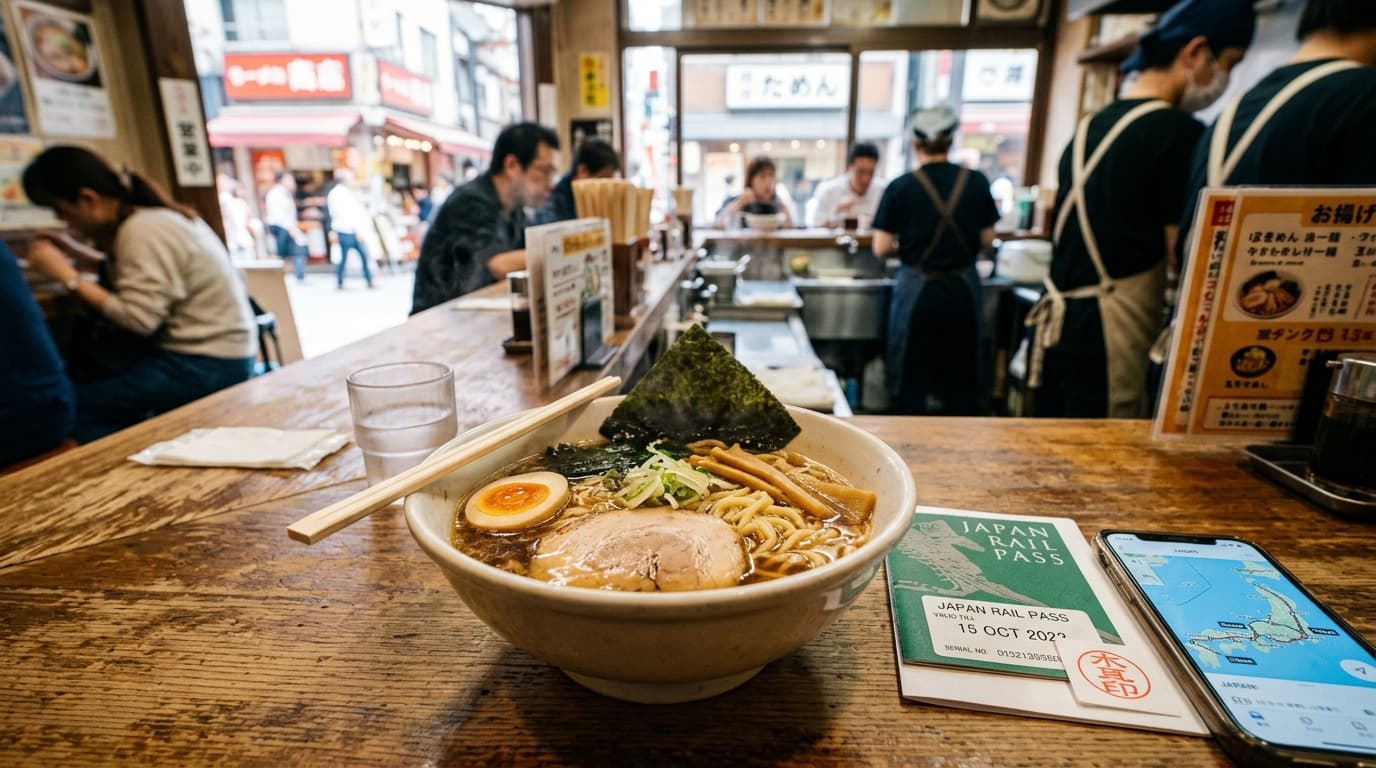
Japan is a country where a bowl of ramen costs ¥700 at a standing bar, where you can buy a filling onigiri at konbini for ¥150, and where a bus pass for a day costs less than a coffee in many Western capitals. The key is understanding the two tiers: tourist tier and local tier. Stay in the local tier and Japan is genuinely affordable.
The 2026 exchange rate also helps enormously. The yen has declined significantly against most major currencies, giving foreign visitors purchasing power not seen since the early 2000s. At ¥150 to the dollar, prices that felt steep in 2015 now look very reasonable.
Where Japan Offers Exceptional Value
Food: This is where Japan punches hardest for budget travelers. A teishoku (set meal) of rice, soup, protein, and pickles at a local restaurant runs ¥800--1,200. Standing sushi (kaiten-zushi) lets you eat well for ¥1,200--1,800. Yakitori and kushikatsu from street vendors or local izakaya cost ¥100--200 per skewer. Convenience stores -- called konbini -- sell legitimately good hot food around the clock for ¥150--600 per item.
Transport within cities: Tokyo's subway charges ¥170--220 per ride. A one-day Tokyo metro pass costs ¥700--900. Osaka's subway is similarly priced. Compared to New York, London, or Paris, this is cheap for an equivalent city.
Temples and shrines: Many are free or ¥500 or less. In Kyoto alone, dozens of the most famous shrines including Fushimi Inari cost nothing to enter. Parks, viewpoints, and public gardens are free across the country.
Where Costs Add Up
Accommodation: This is your primary expense. Tokyo and Kyoto especially have elevated hotel prices during peak season. Even budget hostels charge ¥2,500--4,500 per night, and business hotels start at ¥6,000--9,000.
Tourist-trap restaurants: The menus posted outside restaurants near major temples and stations in tourist areas often reflect a 100--200% premium over local equivalents. Walking two or three blocks away consistently halves the price.
Intercity travel: Shinkansen tickets are not cheap. Tokyo to Kyoto on the shinkansen costs ¥13,850 one-way ($92 USD). This is where trip planning matters -- more on this below.
2. Daily Budget Breakdown
Here is a realistic breakdown for a full budget day in Japan:
Budget Day (~¥10,000 / ~$67 USD)
| Expense | Cost |
|---|---|
| Hostel dorm bed | ¥2,500 |
| Konbini breakfast (onigiri + coffee) | ¥350 |
| Ramen for lunch | ¥800 |
| Metro day pass | ¥800 |
| Temple entry (1--2 temples) | ¥500 |
| Izakaya dinner (2 dishes + 1 beer) | ¥1,500 |
| Snacks / incidentals | ¥400 |
| Total | ¥6,850 (~$46) |
Comfortable Budget Day (~¥14,000 / ~$93 USD)
| Expense | Cost |
|---|---|
| Capsule hotel (private pod) | ¥4,500 |
| Café breakfast | ¥700 |
| Teishoku lunch at a local restaurant | ¥1,000 |
| Transport | ¥1,000 |
| Activity (museum, garden, experience) | ¥1,500 |
| Sit-down ramen + gyoza dinner | ¥1,800 |
| Snacks + drinks | ¥600 |
| Total | ¥11,100 (~$74) |
3. Accommodation: Getting the Best Budget Beds
Japan's hostel scene is excellent. Unlike in some countries where budget means poor maintenance and dubious linen, Japanese hostels tend to be clean, organized, and well-run. Many include free breakfast, a communal kitchen, and free luggage storage.
Types of Budget Accommodation
Capsule hotels range from ¥2,500 to ¥5,000 per night. Modern capsule hotels (as opposed to the traditional salaryman ones) offer private pods with a curtain or sliding door, a power outlet, reading light, and shared shower facilities. In Tokyo's Asakusa and Shinjuku neighborhoods you will find excellent capsule hotels.
Hostels are typically ¥2,500--3,500 per night for a dorm bed. Private rooms in hostels start at ¥5,000--7,000. Many are social and well-located.
Business hotels (Toyoko Inn, APA Hotel, Super Hotel) are reliable budget hotel chains charging ¥5,000--8,000 per night for a small but clean private room. If you are traveling solo, these can be good value.
Manga cafés (manga kissa) charge ¥1,500--2,500 for a private booth for several hours, and some allow overnight stays. They are not ideal for a real night's sleep but are useful for very late arrivals or early departures.
Booking Tips
- Book Kyoto accommodation at least 6--8 weeks ahead, especially for cherry blossom season (late March -- early April) and autumn foliage season (November). Prices double or triple during these windows.
- Osaka is typically 20--30% cheaper than Kyoto and an easy train ride away. Many budget travelers base themselves in Osaka and day-trip to Kyoto.
- Avoid booking accommodation near Kyoto Station -- the tourist premium is highest there.
4. Food: Eating Well on Almost Nothing
Japan's food culture is a budget traveler's dream. The full-service restaurant is just one of many options, and usually not the most interesting one.
The Konbini Strategy
Japanese convenience stores -- 7-Eleven, FamilyMart, Lawson -- are a genuine dining option, not a fallback. Freshly made onigiri, hot nikuman (steamed pork buns), oden stew from the pot, sandwiches, and hot coffee from the machine are all good. Spend ¥350--500 and you have a breakfast or light lunch that is far better than a gas station snack anywhere else in the world.
Standing Restaurants and Teishoku Shops
Tachigui (standing restaurants) serve soba, udon, ramen, and rice dishes for ¥500--900. You will find them at train stations, in basement food halls, and on side streets near offices. These are where locals eat lunch. Teishoku shops serve complete balanced meals -- rice, miso soup, a main dish, pickles -- for ¥800--1,200 at lunch, often ¥200 more at dinner.
Depachika and Market Halls
Department store basement food halls (depachika) in cities like Tokyo, Osaka, and Nagoya sell discounted prepared foods in the evening -- typically after 6pm -- when vendors reduce prices on unsold items. You can eat very well for ¥500--800 this way.
Where to Spend a Little More
A proper set lunch at a higher-end restaurant (tempura, sushi, kaiseki) often costs ¥2,000--4,000 -- sometimes a fraction of the same establishment's dinner price. Lunch sets at nice restaurants are one of Japan's great value secrets.
5. Transport: The Smart Budget Approach
Within Cities
Use the metro and bus. Tokyo's extensive metro and JR urban rail network covers the entire city. Buy an IC card (Suica or Pasmo) on arrival at the airport -- it works on virtually every train, subway, and bus in Japan, and even at konbini. Top it up as needed. Never buy individual tickets if you can avoid it; the IC card tap-in/tap-out system is cheaper and faster.
Between Cities
This is where budget matters most. Options ranked by cost:
- Night buses (yakou bus): ¥3,000--6,000 for Tokyo--Osaka. Slow (8+ hours) but you save a night's accommodation. The Willer Express and JR Bus Kanto networks are reliable.
- Budget airlines: Peach Aviation, Jetstar Japan, and StarFlyer cover domestic routes cheaply. Tokyo to Fukuoka can be ¥3,000--6,000 if booked ahead. Factor in bag fees and airport access time.
- JR Pass: The 7-day pass costs around ¥50,000 ($340 USD). It covers unlimited shinkansen travel on JR lines (not Nozomi or Mizuho super-express). Worth it if you are doing a Tokyo--Kyoto--Hiroshima--Osaka route with side trips. Break-even analysis: a single Tokyo--Osaka round-trip by shinkansen costs about ¥28,000, so two intercity journeys can already justify a 7-day pass.
- Standard shinkansen: Fast, punctual, comfortable, but expensive per-trip. Reserve seats ahead for busy periods to guarantee a seat.
6. Activities and Sightseeing
Japan is full of free and very cheap things to do.
Free Activities
- Walking through Fushimi Inari in Kyoto (open 24 hours)
- Exploring the Tsukiji Outer Market in Tokyo
- Hiking in national parks and mountain trails across Hokkaido, Tohoku, and the Japanese Alps
- Visiting Meiji Shrine in Tokyo (free)
- Strolling Arashiyama bamboo grove in Kyoto
- Watching the auction preparation at Nishiki Market in Kyoto
- Exploring neighborhoods: Yanaka in Tokyo, Gion in Kyoto, Dotonbori in Osaka
- Castle grounds (Osaka Castle exterior, Matsumoto Castle town)
Low-Cost Activities
- Temple and shrine entries: ¥300--600 for most
- National museums: ¥600--1,000 general admission
- Senso-ji in Asakusa, Tokyo: free
- Hiroshima Peace Memorial Museum: ¥200
- Sumo viewing (tournament tickets): ¥3,800 for ground-level seats purchased on the day
Worth the Splurge
- A Michelin Bib Gourmand lunch: ¥2,000--4,000
- One night at an entry-level ryokan with dinner and breakfast: ¥12,000--18,000 per person
- A cooking class in Kyoto or Osaka: ¥4,000--8,000
- A day trip to Hakone with onsen included: ¥6,000--8,000 with the Hakone Free Pass
7. Money and Payments in Japan
Japan is still heavily cash-based outside major cities. Always carry yen.
ATMs: 7-Eleven ATMs and Japan Post offices accept foreign cards and are the most reliable. Set your home bank's daily limit to at least ¥30,000 ($200) before travel. Convenience store ATMs typically charge ¥110--220 per withdrawal.
IC cards: Top up your Suica or Pasmo with ¥3,000--5,000 at a time to cover all local transit and konbini purchases.
Credit cards: Major hotels, department stores, and tourist restaurants accept them. Many small restaurants, ramen bars, and local shops are cash only. The rule: assume cash is needed outside tourist-facing businesses.
Currency exchange: Airport exchange counters offer mediocre rates. 7-Eleven ATMs and Japan Post ATMs with a Wise or Revolut card will get you close to the mid-market rate.
8. Sample Itinerary: 10 Days Under $100/Day
A realistic 10-day budget trip to Japan:
Days 1--3: Tokyo -- Hostels in Asakusa ¥2,800/night, metro day pass, free parks and shrines, cheap ramen and konbini. Daily average: ~¥9,000.
Day 4: Night bus to Kyoto -- Overnight bus ¥4,500, saves accommodation. Arrive early, deposit bags, explore Fushimi Inari (free).
Days 5--6: Kyoto -- Capsule hotel ¥3,800/night, temple passes (¥500/each), teishoku lunches, local izakaya dinners. Daily average: ~¥10,000.
Day 7: Day trip to Nara -- Return train from Kyoto ¥700 round-trip, Nara deer park free, Todaiji ¥600. Day average: ~¥6,000.
Day 8: Osaka -- Easy train from Kyoto (¥570). Hostel in Namba area ¥3,000. Dotonbori food, cheap takoyaki. Daily average: ~¥8,500.
Days 9--10: Hiroshima and Miyajima -- Bus or local train from Osaka (~¥4,000), Peace Museum ¥200, Miyajima ferry ¥450. Hostel ¥2,800/night. Daily average: ~¥9,000.
Total 10-day budget estimate: ¥85,000--100,000 ($570--670 USD) -- well under $100/day including all accommodation and food.
Japan rewards the traveler who eats local, sleeps practically, and moves by train and bus rather than taxi. The country is structured around public life: public transit, public baths, public parks, public markets. All of these are cheap. The expensive layer -- luxury ryokans, private cars, high-end kaiseki -- is real, but it is entirely optional. You can have a rich, full, deeply satisfying trip to Japan for under $100 a day. Many do it for far less.
Sources & References
This article is based on first-hand experience and verified with the following official sources:

Go2Japan Team
Exploring Japan since 2021 | 35+ prefectures visited | Updated monthly
We are a team of travel writers and Japan enthusiasts who explore the country year-round. Our guides are based on first-hand experience, local knowledge, and verified official sources.
More about us →People Also Read

Japan Travel Budget 2026: Real Daily Costs, Sample Budgets & Money-Saving Tips
Real 2026 Japan travel costs: daily budgets from ¥3,000–¥15,000+, accommodation, food, transport & activities. Save money without sacrificing experiences.
Japan Budget vs Luxury Travel: What's Worth Splurging On
Real costs for budget and luxury Japan travel. Save on food, splurge on experiences. Exact prices in JPY and USD with sample day budgets.
Japan on $50 Per Day: A Realistic Budget Travel Guide
Travel Japan on $50/day with our realistic budget guide. Exact costs in JPY/USD, sample day budgets, and insider money-saving tips.

Japan in Peak Season vs Low Season: Honest Comparison
Peak vs low season in Japan: crowds, costs, weather, and festivals compared. Plan smarter with honest pros and cons for each season.
Plan Your Japan Trip
Book hotels, transport, activities, and get connected with an eSIM
Some links are affiliate links. We may earn a commission at no extra cost to you.