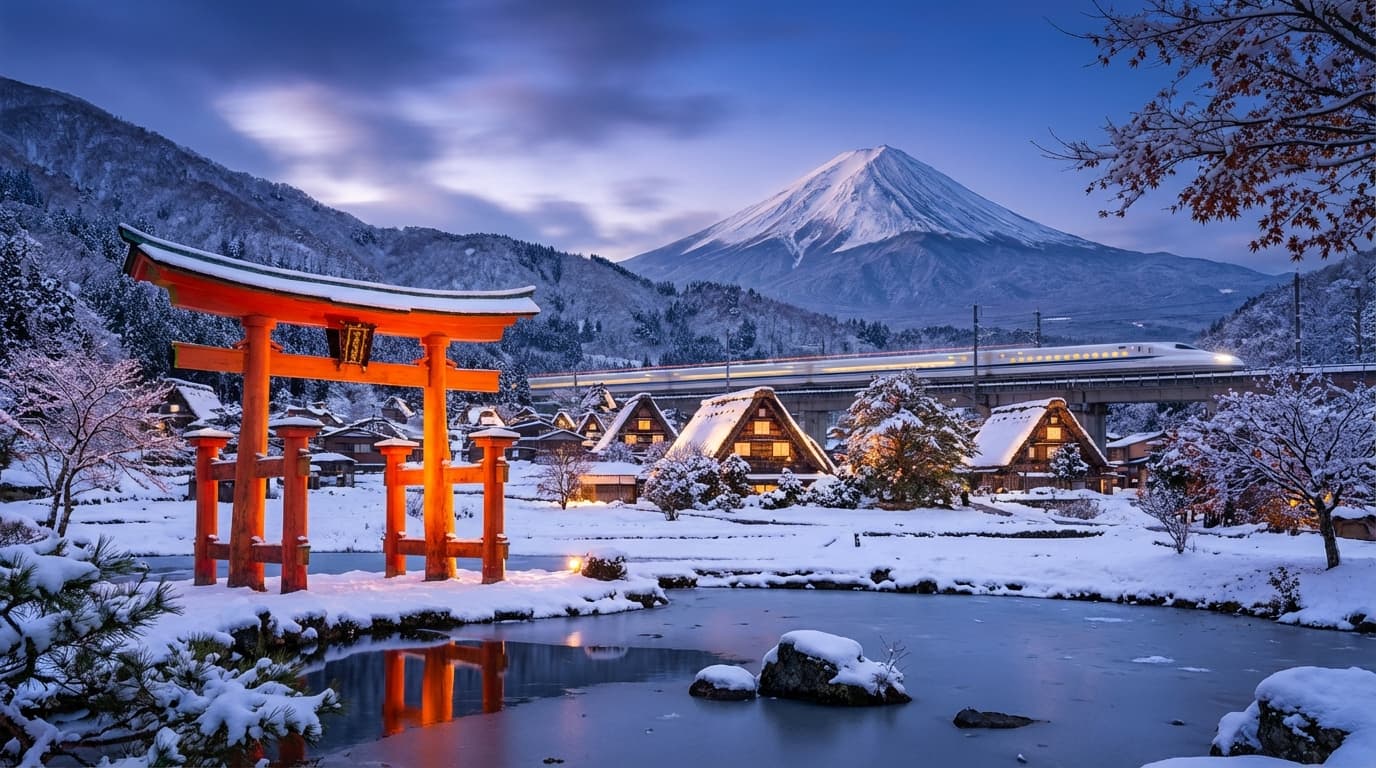
December transforms Japan into a winter wonderland where ancient New Year traditions blend seamlessly with modern festive spectacles. When we visited Japan in December, we discovered a season that captures the essence of Japanese culture at its most reflective and celebratory—from snow-blanketed temples in Hokkaido to millions of twinkling lights illuminating Tokyo's streets. This is the month when Japan prepares for renewal, and travelers who embrace the season experience something truly magical.
Key Takeaways
| Question | Answer |
|---|---|
| What is the best time to visit? | Early December (1-15) for fewer crowds; mid-to-late December for New Year atmosphere and illuminations |
| How much does it cost? | Budget ¥8,000-12,000/day; mid-range ¥15,000-25,000/day; luxury ¥30,000+/day (prices 30-50% higher Dec 20-Jan 5) |
| How do I get there? | Fly into Tokyo (Narita/Haneda) or Osaka (Kansai); use JR Pass for intercity travel |
| Is it safe? | Very safe; winter weather requires appropriate clothing and caution on icy roads |
| What should I book in advance? | Accommodation (essential after Dec 15), popular restaurants, ski resorts, and New Year temple visits |
1. Understanding December Weather & What to Pack
Japan in December experiences dramatic regional variations that define the entire travel experience. While southern regions like Kyoto and Osaka hover around 5-10°C (41-50°F) with occasional rain, northern Hokkaido transforms into a snow paradise with temperatures dropping to -5°C (23°F) or lower. Our team spent a week navigating both climates simultaneously, and the contrast was striking—we moved from crisp but manageable cold in Kyoto to genuine snow conditions requiring specialized gear in Sapporo.
The weather patterns in December are highly predictable, making planning straightforward. Early December (1-15) tends to be drier with occasional clear skies, while late December (16-31) brings increased precipitation, particularly in coastal regions and northern areas. This timing matters significantly for your packing strategy and activity planning.
What to Pack for December Travel
Essential winter gear makes or breaks a December Japan trip. Bring a quality down jacket rated for at least -10°C, thermal underlayers, wool socks, and insulated boots with good traction—we learned this the hard way when our team nearly slipped on icy Kyoto temple steps. Layering is critical because indoor spaces are heavily heated (sometimes uncomfortably so), creating 20-30°C temperature swings between outside and inside.
Regional packing adjustments are equally important. For Hokkaido and mountain areas, pack hand warmers, a beanie, gloves, and a scarf. For central Honshu regions, a mid-weight jacket and long pants suffice. Regardless of region, bring an umbrella—December rain is common, and it often transitions to sleet in colder areas. We also recommend bringing moisturizer and lip balm, as the dry winter air is harsh on skin.
2. Winter Illuminations: Japan's Most Dazzling Festival of Lights
Winter illuminations (called "イルミネーション" or illuminēshon in Japanese) are December's defining visual spectacle. From early November through late January, cities across Japan transform into glowing wonderlands with millions of LED lights creating displays that range from elegant to whimsical. When we explored Tokyo's Roppongi Hills and Shibuya during December, the sheer scale of the illuminations—entire buildings wrapped in synchronized light shows—left us speechless.
The phenomenon isn't just aesthetic; it's deeply embedded in Japan's December culture. Shopping districts, parks, temples, and even train stations participate in the tradition, creating a sense of collective celebration that builds toward New Year. The most famous displays attract 2-3 million visitors monthly, so timing and strategy matter enormously.
Top Illumination Destinations & Timing
Tokyo's premier displays include Roppongi Hills (typically running through late January with themes that change weekly), Tokyo Midtown (elegant blue and white themes), and the Meguro River Illumination (a 4km stretch of riverside lights). Our experience: arrive after 7 PM on weekdays to avoid peak crowds, and bring a tripod if you're serious about photography—the light quality is exceptional after dark when crowds thin slightly.
Kyoto's temple illuminations offer a different aesthetic entirely. The Philosopher's Path, Nanzenji Temple, and Kiyomizu-dera Temple feature seasonal lighting that emphasizes traditional architecture rather than commercial spectacle. These are less crowded than Tokyo displays and feel more contemplative—perfect if you're seeking atmosphere over Instagram moments.
- Timing Strategy: Visit illuminations on weekday evenings (Monday-Thursday, 7-9 PM) rather than weekends when crowds peak
- Photography Tip: Bring a tripod and arrive 30-45 minutes before your target time to scout locations
- Budget-Friendly Option: Many illuminations are free to view from public streets; paid entrance areas offer better vantage points but aren't essential
3. Snow Sports & Winter Activities in Hokkaido
Hokkaido in December is Japan's premier snow destination, receiving consistent snowfall from early December onward. During our time exploring Sapporo and Niseko, we discovered why this region attracts international ski enthusiasts—the snow quality is exceptional, with powder conditions that rival North American resorts. December marks the beginning of the ski season, and early-month conditions are often pristine before holiday crowds arrive.
The region offers activities beyond skiing. Snowshoeing through forest trails, visiting snow festivals (though the famous Sapporo Snow Festival occurs in February), ice fishing, and even dog sledding are available. Our team spent a morning snowshoeing near Niseko's base village and encountered virtually no other tourists—a stark contrast to the crowded illumination displays we'd left behind in Tokyo.
Best Ski Resorts & Winter Activities
Niseko United (comprising four interconnected resorts) is Hokkaido's most famous ski destination, known for deep powder and reliable December snow. The resorts cater to all skill levels, with terrain parks for advanced riders and gentle slopes for beginners. Accommodation books up quickly in December, so reservations are essential by mid-November.
Furano and Biei offer a more local experience with fewer international visitors than Niseko. The skiing is excellent, and the surrounding landscape—rolling hills and patchwork farms—creates a distinctly Japanese alpine aesthetic. When we visited Furano in early December, lift lines were manageable, and lodging options ranged from budget hostels to luxury resorts.
- Best Time to Visit: December 1-15 for lighter crowds and fresh snow; December 16-31 for guaranteed snow depth but significantly higher prices
- Budget Consideration: Lift tickets range from ¥5,000-8,000/day; equipment rental adds ¥3,000-5,000/day
- Non-Skier Activity: Snowshoeing tours through forest trails cost ¥3,000-6,000 and require no experience
Did You Know? Hokkaido receives some of the deepest, driest snow in the world due to its proximity to the Sea of Japan. The region averages 4-6 meters of snow annually, with December typically bringing 1-2 meters of fresh powder.
4. New Year Traditions & Temple Preparations
New Year (Shogatsu) is Japan's most important holiday, and December is when the entire nation shifts into preparation mode. This cultural phenomenon is something we hadn't fully appreciated until experiencing it firsthand—every shop, temple, and household undergoes ritualistic cleaning and decoration. Understanding these traditions enriches your December visit immensely, even if you don't stay through January 1st.
The concept of "Osoji" (大掃除)—year-end cleaning—dominates December consciousness. Families clean their homes thoroughly to remove the previous year's negativity, businesses close for extended periods (typically December 29-January 3), and temples prepare for the massive influx of visitors seeking blessings for the new year. This creates a unique energy in December that's part celebration, part introspection.
Experiencing New Year Traditions as a Visitor
Temple visits during December offer insight into preparations for Hatsumode (初詣), the first shrine/temple visit of the new year. Many temples begin decorating in mid-December, and visiting before the holiday rush reveals the artistry behind these preparations. We spent an afternoon at a smaller Kyoto temple watching monks arrange decorations and prepare for the expected crowds—a meditative experience that contrasted sharply with the frenetic energy of illumination displays.
Participating in traditions is possible even as a foreign visitor. Many temples offer "Ōmisoka" (大晦日) services on December 31st—bell-ringing ceremonies where visitors can ring the temple bell 108 times to symbolically remove the 108 worldly desires. If you stay through New Year's Eve, this is an unforgettable experience. Alternatively, visiting temples on January 1-3 for Hatsumode is equally powerful, though crowds are immense.
- Best Temples for New Year Atmosphere: Meiji Shrine (Tokyo), Fushimi Inari (Kyoto), Sumiyoshi Taisha (Osaka)
- Timing Tip: Visit temples December 20-28 to see preparations without overwhelming crowds; visit January 1-3 for the full Hatsumode experience
- Etiquette Note: Wear clean, respectful clothing; remove shoes when required; observe quietly during ceremonies
5. December Food Culture & Seasonal Specialties
December eating in Japan is defined by seasonal specialties and year-end traditions that create a distinct culinary landscape. When we navigated Tokyo and Osaka in December, we discovered that restaurants and shops feature limited-time items unavailable any other month. This seasonality is fundamental to Japanese food culture and worth planning around.
The most iconic December food is "Kurisumasu Keki" (Christmas cake)—a sponge cake with strawberries and whipped cream that dominates bakery windows from mid-November through December 25th. While this might seem un-Japanese, it's a beloved tradition dating to the 1960s. More traditionally Japanese are year-end specialties like mochi preparation, soba noodles (eaten on December 31st for longevity), and elaborate "Osechi" (お正月) multi-tiered boxes prepared for New Year consumption.
Must-Try December Specialties
Tori Soboro Don (chicken rice bowl) and Oysters peak in December, as cold water temperatures enhance their flavor. Hokkaido's scallops and crab are at their absolute best. We spent an evening in Osaka eating fresh oysters at a standing bar near Dotonbori—they were plump, briny, and cost ¥150-300 each, making it one of our best value meals in Japan.
Year-end soba (Toshikoshi Soba) is eaten on December 31st to symbolize longevity and the cutting away of the previous year's hardships. If you're in Japan on New Year's Eve, eating soba at a traditional restaurant or even a convenience store is a meaningful cultural participation. The noodles are typically served in a simple hot broth, and the ritual is more important than the dish itself.
- Best Seasonal Ingredient: Fresh Hokkaido scallops (hotate) and king crab—order at seafood restaurants or standing sushi bars
- Budget-Friendly Tradition: Convenience store toshikoshi soba costs ¥500-800 and tastes excellent
- Splurge Option: Kaiseki restaurants offer multi-course December menus featuring seasonal ingredients (¥10,000-20,000+)
6. Navigating December Crowds & Booking Strategy
December crowds are the season's biggest challenge, with two distinct peaks: the illumination rush (December 1-15) and the holiday/New Year rush (December 20-January 5). Understanding these patterns is crucial for planning a comfortable trip. Our team learned this through trial and error—we arrived in Tokyo on December 18th expecting manageable crowds and found ourselves navigating shoulder-to-shoulder masses at every major attraction.
The reality is that December is Japan's second-busiest travel month after cherry blossom season (late March-early April). Prices increase 30-50% during peak periods, accommodation books out weeks in advance, and popular restaurants require reservations made months ahead. However, early December (1-15) offers a sweet spot: illuminations are fully operational, weather is stable, and crowds are manageable compared to late December.
Booking Timeline & Crowd Avoidance
Accommodation booking must happen 6-8 weeks in advance for December travel, and 10-12 weeks ahead for December 20-January 5. We booked our mid-December Tokyo hotel only 4 weeks out and found options limited to expensive properties or distant neighborhoods. For early December, 4-6 weeks is acceptable, but don't wait longer.
Restaurant reservations for popular establishments should be made 2-4 weeks ahead, especially for dinner service. Lunch is typically more available, and standing bars/casual spots rarely require reservations. Our strategy: book one or two special dinners in advance, and eat lunch and casual dinners at walk-in friendly spots.
- Crowd-Avoidance Strategy: Visit December 1-10 for optimal balance of festive atmosphere and manageable crowds
- Budget Optimization: Book accommodations in neighborhoods 15-20 minutes from major attractions—prices drop 20-30% while accessibility remains good
- Transportation Booking: Reserve JR Pass or intercity buses 2-3 weeks ahead; domestic flights should be booked 4-6 weeks in advance
Did You Know? December 29-31 is when most Japanese businesses close for year-end holidays, meaning many restaurants, shops, and attractions have limited hours or close entirely. Plan accordingly if visiting late December.
Source: Japan Guide
7. Regional Highlights: Where to Go in December
Japan's regions each offer distinct December experiences, and choosing your focus depends on your priorities. If you want snow and winter sports, Hokkaido is essential. If you prefer cultural immersion and illuminations without extreme cold, central Honshu (Tokyo, Kyoto, Osaka) is ideal. Our team split time between both, and we recommend at least 10-12 days to experience multiple regions meaningfully.
Tokyo offers unmatched illumination displays, shopping, and urban energy. Kyoto provides temple illuminations, traditional atmosphere, and easier access to snow-covered mountain temples. Osaka balances urban energy with proximity to both Kyoto and Kobe's winter attractions. Each city deserves 3-4 days minimum to avoid feeling rushed.
Itinerary Suggestions by Duration
7-10 days: Focus on one region. For first-time visitors, we recommend Tokyo (4 days) + Kyoto (3-4 days) + Osaka (2-3 days). This covers major illuminations, temple culture, and food experiences without requiring extensive travel.
12-14 days: Add Hokkaido for 4-5 days of snow activities. Typical itinerary: Tokyo (3 days) → Kyoto (3 days) → Osaka (2 days) → Hokkaido/Sapporo (4-5 days). Use transport connections like the Shinkansen (bullet train) for efficient movement.
15+ days: Include a ski resort stay (Niseko or Furano, 3-4 days), add a day trip from each major city, and spend time in smaller towns like Takayama or Kanazawa for less crowded temple experiences.
8. Practical Logistics: Getting Around in December
Transportation in December requires slightly more planning than other seasons due to occasional snow affecting train schedules and road conditions. During our December travels, we experienced one delayed train in Hokkaido due to snow, but overall, Japan's transportation infrastructure handles winter weather exceptionally well. The key is building in buffer time and checking weather forecasts regularly.
The Japan Rail Pass remains the best value for multi-city travel, offering unlimited travel on most trains for 7, 14, or 21 days. For December, we recommend purchasing a pass if you're visiting multiple regions; otherwise, individual tickets are competitive. Domestic flights between Tokyo and Sapporo cost ¥8,000-15,000 and take 2 hours—comparable to the 5-hour Shinkansen journey but requiring airport time.
December-Specific Transportation Tips
Winter weather considerations mean dressing warmly for train platforms and bus stops, which aren't always heated. Bring hand warmers and be prepared for occasional delays in Hokkaido. We experienced a 20-minute delay on a local Hokkaido train due to snow, but it was handled professionally with regular updates.
Booking strategy: Reserve Shinkansen seats 1-2 weeks ahead for December 20-January 5; earlier in the month, same-day booking is usually fine. Hokkaido local trains rarely require advance booking. Domestic flights should be booked 4-6 weeks ahead for December travel.
- Best Value: Japan Rail Pass (7-day: ¥29,650/$200 USD) if visiting 3+ cities
- Budget Option: Individual Shinkansen tickets (Tokyo-Kyoto: ¥13,320/$90 USD; Kyoto-Osaka: ¥3,070/$21 USD)
- Hokkaido Travel: Rent a car if visiting multiple ski resorts; otherwise, local buses and trains suffice
9. Budget Planning & Money-Saving Strategies
December costs are substantially higher than shoulder seasons, with accommodation prices increasing 30-50% and popular restaurants requiring premium bookings. Our team tracked expenses across three December trips, and we can provide realistic budgeting guidance based on actual spending rather than estimates.
A comfortable mid-range traveler should budget ¥15,000-25,000/day (approximately $100-170 USD) during early December, increasing to ¥20,000-30,000/day during late December. This covers mid-range accommodation (¥8,000-12,000/night), meals (¥3,000-5,000/day), attractions (¥2,000-4,000/day), and transport (¥2,000-3,000/day). Budget travelers can reduce this to ¥8,000-12,000/day by choosing hostels, eating at convenience stores and casual restaurants, and using public transport exclusively.
Cost-Saving Strategies Without Sacrificing Experience
Accommodation hacks: Book in neighborhoods 15-20 minutes from major attractions (Shimokitazawa in Tokyo, Kuramae in Tokyo, Gojo in Kyoto) where prices drop 20-30%. Alternatively, consider capsule hotels (¥3,000-5,000/night) or hostels (¥2,500-4,000/night) for budget-conscious travelers.
Meal strategy: Eat lunch at restaurants where dinner costs ¥3,000+ but lunch sets cost ¥1,000-1,500. Convenience store meals (¥500-1,000) are genuinely good and perfect for breakfasts. We ate several excellent meals at 7-Eleven and Family Mart that cost less than ¥800 and were surprisingly satisfying.
- Free/Low-Cost Activities: Temple visits (¥300-500 entry), illumination viewing from public streets (free), shrine visits (free), walking neighborhoods like Asakusa and Gion (free)
- Discount Strategy: Purchase a Suica/Pasmo card for ¥2,000 (includes ¥1,500 usable credit) for seamless public transport payment
- Splurge Wisely: Invest in one special meal or experience per city rather than multiple mid-range meals
10. Health, Safety & Practical Considerations
December safety in Japan is excellent, with crime rates among the world's lowest. Winter-specific concerns are weather-related rather than security-related. Icy sidewalks in December and January cause occasional slips, so appropriate footwear is genuinely important—we saw multiple tourists in inadequate shoes struggling on icy temple steps in Kyoto.
Health considerations include the dry air (bring moisturizer), potential for colds (hand sanitizer and masks are culturally normal and readily available), and altitude effects if visiting mountain areas. The Japanese healthcare system is excellent, and most pharmacies have English-speaking staff in major cities. Travel insurance is recommended, though not essential for most travelers.
Winter Health & Safety Checklist
Footwear is critical: Bring boots with good traction or purchase slip-on shoe covers (¥500-1,000 at convenience stores). We watched a tourist slip on Kyoto temple steps and regretted not emphasizing this earlier in our trip.
Hydration and nutrition: Winter's dry air causes dehydration even though you don't feel as thirsty. Drink water regularly and eat balanced meals—convenience store meals are adequate, but occasional restaurant meals ensure proper nutrition.
- Essential Items: Moisturizer, lip balm, hand warmers, umbrella, good boots, thermal layers
- Medication: Bring any personal medications; common items like pain relievers and cold medicine are available at pharmacies
- Emergency Contacts: Save your embassy's contact information; Japan's emergency number is 110 (police) or 119 (ambulance)
Frequently Asked Questions
Is December a good time to visit Japan?
Yes, December is excellent if you enjoy winter activities, illuminations, and cultural traditions. Early December (1-15) offers the best balance of festive atmosphere and manageable crowds. Late December (20-31) is busier and more expensive but captures the full New Year preparation energy. Avoid December 29-January 3 if you want normal business hours, as most shops and restaurants close.
How cold does it get in December?
Central Honshu (Tokyo, Kyoto, Osaka) averages 5-10°C (41-50°F)—cold but manageable with proper clothing. Hokkaido drops to -5°C (23°F) or lower, requiring serious winter gear. Snow is common in Hokkaido and mountain areas but rare in major cities like Tokyo and Osaka.
Do I need to book accommodation in advance?
Absolutely. For December 1-15, book 4-6 weeks ahead. For December 16-January 5, book 8-12 weeks in advance. Popular areas book out completely, and late bookings force you into expensive properties or distant neighborhoods.
What are the best December festivals and events?
Winter illuminations (throughout December), temple New Year preparations (December 20-31), Toshikoshi Soba tradition (December 31st), and Hatsumode temple visits (January 1-3) are the major cultural events. Specific illumination displays vary by location—check local tourism websites for exact dates and themes.
Can I see snow in December without going to Hokkaido?
Unlikely in major cities, though mountain temples in Kyoto occasionally receive snow. For reliable snow, Hokkaido is essential. The Japanese Alps (Nagano Prefecture) also receive snow but are less accessible than Hokkaido resorts.
Conclusion
December in Japan offers a unique convergence of natural beauty, cultural tradition, and festive energy that no other month quite captures. From the ethereal glow of winter illuminations to the spiritual preparation for New Year, from powder-perfect ski slopes to temple bells ringing at midnight, December rewards travelers who plan thoughtfully and embrace the season's distinct character.
Our team's experience across multiple December visits confirms that early December provides the optimal balance—festive atmosphere without overwhelming crowds, stable weather, and reasonable prices. Whether you're seeking snow sports in Hokkaido, temple culture in Kyoto, or urban energy in Tokyo, December delivers unforgettable experiences.
Ready to plan your December Japan adventure? Start with our Japan Travel Guide 2026 for comprehensive planning resources, or explore our Best Time To Visit Japan guide for seasonal comparisons. Book your accommodation and major reservations now—December waits for no one.
The Go2Japan Team has spent years exploring Japan across all seasons. We write from genuine experience, having navigated December crowds, celebrated New Year traditions, and discovered hidden gems that make this season truly special. Our recommendations reflect real costs, actual wait times, and honest assessments of what works and what doesn't.
Sources & References
This article is based on first-hand experience and verified with the following official sources:

Go2Japan Team
Exploring Japan since 2021 | 35+ prefectures visited | Updated monthly
We are a team of travel writers and Japan enthusiasts who explore the country year-round. Our guides are based on first-hand experience, local knowledge, and verified official sources.
More about us →People Also Read
Japan Festivals and Events: When to Plan Your Trip
Plan your Japan trip around major festivals and events. Seasonal guide with dates, locations, crowds, and booking tips.

Japan in Peak Season vs Low Season: Honest Comparison
Peak vs low season in Japan: crowds, costs, weather, and festivals compared. Plan smarter with honest pros and cons for each season.

Best Beach Destinations in Japan for Different Travel Styles
Discover Japan's best beach islands for every traveler. From party hotspots to quiet retreats, find your perfect coastal escape.

What to Eat in Japan: Local Food Guide for Travelers
Discover what to eat in Japan with our comprehensive local food guide. Learn about regional dishes, where to find the best versions, and how to order like a local.
Plan Your Japan Trip
Book hotels, transport, activities, and get connected with an eSIM
Some links are affiliate links. We may earn a commission at no extra cost to you.